
Views: 168 Author: Onustec Group Publish Time: 2026-02-18 Origin: Site


Precision in metal fabrication is often defined by the quality of preparation before assembly even begins. Whether you are welding structural steel pipes or assembling intricate aluminum curtain walls, the geometry of your connection points dictates the structural integrity of the final product. The Notching Saw serves as the critical gatekeeper in this process, responsible for minimizing "fit-up" gaps that lead to weld failures or aesthetic defects. However, industrial notching is not a monolithic category. It splits sharply into two disciplines: tube notching for welding readiness, and profile notching for mechanical joint precision.
Selecting the wrong equipment can lead to expensive bottlenecks, wasted material, and dangerous working conditions. This guide navigates the technological landscape, from manual field tools to advanced CNC systems. We evaluate the trade-offs between initial capital expenditure and long-term operational costs to help you select the right machine for your production floor.

Application Dictates Technology: Tube notchers (hole saw/abrasive) prioritize weld readiness; profile notchers (bladed/milling) prioritize aesthetic geometry and mechanical locking.
Automation Levels: From manual field tools to 5-axis CNC notching saws, ROI depends on batch size and geometric complexity (e.g., compound mitres).
Hidden Costs: Low-cost abrasive notchers increase TCO via consumable belts and required deburring; CNC milling reducers labor but requires higher CapEx.
Safety & Compliance: Modern automatic notching saws feature enclosed machining zones and reverse-rotation blades to mitigate operator risk.
Before evaluating horsepower or blade diameters, you must determine the correct machine class. Industrial notchers are generally purpose-built. A machine excellent at cutting stainless steel pipe will ruin an anodized aluminum window frame, and vice versa. Understanding this bifurcation is the first step in procurement.
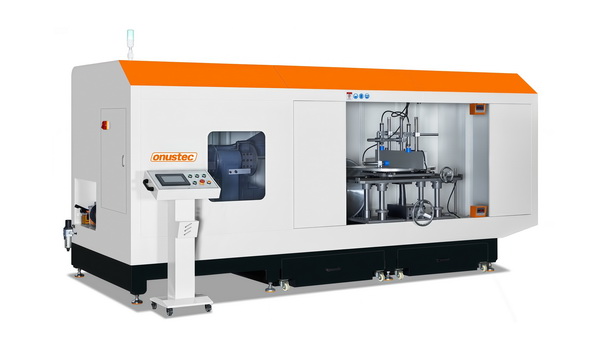
In structural steel fabrication, the primary goal is creating a "Saddle Notch" or "End Notch." This is a semi-circular cut at the end of a tube that allows it to mate perfectly with the side of another tube, creating a T-joint or angled connection. The success metric here is the tightness of the "Weld Fit-Up."
If the gap between tubes is too wide, welders must fill it with excessive filler material. This increases heat input, causing distortion and creating a weak point in the structure. Common technologies used here include hole saws driven by drill presses, abrasive belt grinders, and eccentric end mills. These tools prioritize speed and the ability to cut through hard ferrous metals.
Conversely, the fenestration industry (windows, doors, facades) requires a different approach. Here, the goal is precision cutting for V-notches, end-milling, and creating complex geometry for curtain walls and winter gardens. The parts are often mechanically locked or screwed together rather than welded.
The success metric for aluminum is assembly speed and the complete lack of "Corrective Cuts." If a mullion does not fit a transom perfectly, the facade will leak, or the visible joinery will look unprofessional. Technologies here range from dual-head bladed saws to sophisticated CNC Notching Saw centers that can mill multiple angles in a single pass.
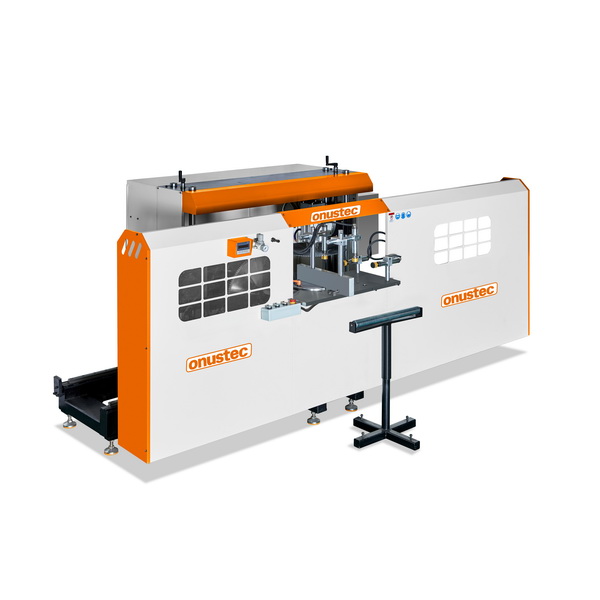
| Feature | Tube/Pipe Notching | Aluminum Profile Notching |
Material Focus | Steel, Stainless, Chromoly (Round) | Aluminum Extrusions (Square/Complex) |
Primary Goal | Weld Fit-Up (Saddle Cuts) | Mechanical Assembly (Mullion/Transom) |
Critical Tolerance | Gap < 1.5mm (Fillable) | Gap < 0.5mm (Visible Defect) |
Typical Tooling | Hole Saws, Abrasive Belts | Carbide Blades, End Mills |
Fabrication shops working on roll cages, handrails, or structural frames face a constant balancing act. You need speed, but you also need clean edges that don't require hours of grinding.
For small shops or field repairs, heavy industrial machinery is often impractical. This is where hole saw notchers dominate. These units use a standard bi-metal hole saw driven by a drill press or a handheld drill. The mechanism creates the saddle cut by drilling through the tube at an angle.
Pros: The barrier to entry is incredibly low. You can purchase a jig for under $300. They are portable, making them ideal for on-site adjustments during installation.
Cons: Repeatability is poor. The hole saw tends to wander/flex, creating uneven cuts. Furthermore, when cutting stainless steel, hole saws wear out rapidly, driving up consumable costs. They are also strictly limited to circular cuts; you cannot easily notch square tubing with this method.
Abrasive belt or drum sanders offer a different approach. These machines grind the notch using a contact wheel (mandrel) that matches the diameter of the mating tube. This method provides fast material removal and has distinct advantages for thin-wall tubing which might collapse under the torque of a hole saw. However, they generate high heat. This creates a "Heat Affected Zone" (HAZ) that can discolor stainless steel and complicate welding. They also produce conductive dust, which poses a fire hazard and requires rigorous cleaning of the workspace.
When production volumes increase, precision becomes non-negotiable. End Mill Notchers, often using an eccentric path, represent the tier above manual tools. A rigid cutter follows a programmed path to create the "fish mouth." This is essential for shops requiring CNC precision without thermal distortion. The cut is cold, clean, and ready for TIG welding immediately.
For High-Volume Low-Mix (HVLM) manufacturing—such as mass-producing furniture frames—Punch Press (Ram) Notchers are the standard. These machines shear the material in a single stroke, a process also known as "Pinch Trimming." While the tooling costs are high (you need a specific die for every tube diameter), the cycle time is measured in seconds rather than minutes.
Architectural fabrication demands geometric perfection. A gap in a curtain wall is not just ugly; it compromises the weather-sealing properties of the building.
In many workshops, standard configurations involve fixed angle (90°) units. However, modern architecture rarely sticks to simple right angles. This drives the need for variable angle capabilities. The challenge with manual variable saws is setup time and human error.
This is why a Digital Display Notching Saw is becoming the minimum standard. Operators no longer need to squint at analog rulers or perform trigonometry on the shop floor. The digital display provides real-time feedback on cut depth and height, significantly reducing calculation errors. Even a semi-automatic machine with digital readouts can improve throughput by 30% compared to purely manual setups.
Safety features are equally critical. Aluminum cutting happens at high RPMs. If a profile is not clamped correctly, the blade can "snatch" the material, launching it across the room. We recommend machines with integrated vertical and horizontal clamping systems. Furthermore, "reverse rotation" blades—where two blades spin in opposite directions—help stabilize the workpiece during the cut.
As designs become more ambitious, manual adjustment becomes a bottleneck. Fabricating pyramids, skylights, or faceted facades requires cutting compound angles that are difficult to set up by hand.
This is the domain of the 5-Axis CNC Notching Saw. These systems automate every variable: cutting angle, notch height, notch depth, and blade swing. They are necessary for complex architectural designs where standard 3-axis machines cannot physically reach the required cutting planes.
Compound mitre capabilities allow these machines to handle Mullion and Transom combinations where multi-plane cuts are required simultaneously. The cycle time efficiency is dramatic. A fully automatic system eliminates the manual machine resetting between different profile batches. You can load a file containing ten different notch geometries, and the machine will execute them sequentially without operator intervention.
Choosing a partner for your machinery is as important as the machine specs. A reputable Notching Saw Manufacturer should be able to guide you through the following criteria based on your specific production data.
There is always a trade-off between flexibility and speed. Do you need to cut simple 90° notches instantly? If so, a Punch/Press system is unbeatable. However, if you are a custom fabrication shop, you likely need variable angles to handle whatever job comes through the door. In this case, a bladed or CNC saw is superior.
You must also evaluate "Fit-Up Quality." Ask for sample cuts. In aluminum profiles, a gap greater than 1mm ruins structural integrity. In pipe welding, while gaps can be filled, doing so increases consumable usage and labor time. High-quality machinery pays for itself by reducing the time welders spend bridging gaps.
Total Cost of Ownership (TCO) extends beyond the purchase price. Secondary operations are the silent killers of profit margins. Abrasive notchers, for instance, are cheap to buy but leave heavy burrs. This requires a secondary station where an employee manually deburrs the part using a file or wire wheel. This labor cost accumulates daily.
Conversely, end mills and cold saws typically produce "ready-to-weld" or "ready-to-assemble" finishes. You also need to calculate consumable costs. An Automatic Notching Saw using carbide blades might have a higher upfront tooling cost, but the blades can be sharpened multiple times, often resulting in a lower cost-per-cut than abrasive belts which are single-use.
If you are investing in CNC, software integration is paramount. Data flow is the nervous system of modern manufacturing. Can the machine accept import files (.dxf, .csv) directly from your BIM or CAD software? Manually typing dimensions into a controller is a recipe for data entry errors.
Look for a user interface that offers visual modeling. The controller should show a 3D representation of the part before cutting. This "check twice, cut once" feature prevents scrapping expensive anodized aluminum extrusions due to programming mistakes.
Bringing a new sawing system onto the floor introduces new infrastructure requirements. High-torque aluminum notchers often require 3-phase power to maintain blade speed during deep cuts. They also demand stable air pressure for pneumatic clamping integrity. If your shop air fluctuates, clamps can loosen mid-cut, damaging the part or the blade.
Chip management is another logistical hurdle often overlooked. You must differentiate between fine abrasive dust and aluminum chips. Abrasive dust is a fire hazard and requires filtration. Aluminum chips are recyclable but voluminous; high-speed saws generate buckets of chips per hour. An integrated conveyor system is not a luxury; it is a necessity for keeping the machine running.
Finally, address the operator skill gap. Moving from manual jigs to a sophisticated system requires training. Operators need to understand coordinate systems, tool offsets, and maintenance schedules. Ensure your supplier offers comprehensive training as part of the installation package.
The "best" saw is ultimately defined by your workflow constraints. Pipe welders require rapid saddle cuts and tolerance for heat, making abrasive or end-mill solutions ideal. Window fabricators demand geometric perfection and clean finishes, necessitating high-speed bladed saws with precise clamping.
While manual machines save on CapEx, modern Automatic Notching Saws drive ROI through reduced scrap rates, faster changeovers, and the elimination of manual deburring labor. As fabrication standards tighten, reliance on manual measurement is becoming a competitive disadvantage.
We recommend conducting an audit of your current "fit-up" time losses. Calculate how many hours your team spends grinding burrs or filling weld gaps. Use this data to justify the investment in higher-precision equipment. The right machine doesn't just cut metal; it cuts inefficiency.
A: A hole saw notcher is a low-cost, manual tool using drill bits, ideal for low-volume or field repairs. An end mill notcher uses a milling cutter (often CNC-controlled) to machine precise profiles, ideal for high-precision industrial manufacturing.
A: A 5-axis system is required when fabricating complex architectural aluminum structures (like faceted curtain walls or pyramids) where notches must be made on compound angles that standard 3-axis or 4-axis machines cannot reach.
A: Generally, no. Steel pipe notchers are designed for round geometry and abrasive/high-torque cutting. Aluminum profile notchers are designed for square/rectangular extrusions and high-speed precision cutting. Using one machine for both risks cross-contamination (corrosion) and poor cut quality.
A: Fish mouthing refers to the U-shaped notch cut into the end of a tube so it fits perfectly against the side of another tube, creating a T-joint ready for welding.
A: A digital display provides real-time feedback on blade height and angle, significantly reducing human error and setup time compared to reading analog scales or rulers.


