
Views: 0 Author: Site Editor Publish Time: 2025-11-05 Origin: Site


At Onustec Group, where German technical expertise meets decades of industrial experience, we continue to rely on cast iron cnc vertical machining center structures for our high-end machining solutions. While innovations in alternative materials have emerged, cast iron remains unmatched in providing vibration damping, thermal stability, and long-term precision required for demanding production environments. Our machines are specifically designed for manufacturers who require consistent surface quality, precise geometries, and long-term reliability. By combining traditional craftsmanship with modern manufacturing practices, Onustec ensures that each machine leverages the intrinsic strengths of cast iron, resulting in exceptional operational performance, minimized downtime, and superior part accuracy.
One of the key advantages of cast iron in CNC vertical machining centers is its exceptional ability to absorb vibrations. During high-speed cutting, even minimal oscillations can compromise surface finish, tool life, and part accuracy. Cast iron’s graphite microstructure acts as a natural damper, dispersing vibrational energy across the material. Unlike welded steel frames or polymer composites, cast iron significantly reduces chatter, allowing cutting tools to maintain optimal contact with the workpiece. This characteristic is critical when machining complex geometries, deep pockets, or high-aspect-ratio features, ensuring every component meets tight tolerances.
Moreover, vibration damping extends tool life by preventing high-frequency oscillations that can lead to premature wear or breakage. In industrial settings where high-speed milling, drilling, or tapping is common, these advantages translate to lower operational costs and higher throughput. The mass and internal damping of cast iron also allow the machine to operate at higher spindle speeds without sacrificing stability, which is particularly important for aluminum, titanium, or composite materials.
Beyond vibration damping, cast iron offers remarkable dimensional stability. Metals expand and contract under heat, but the mass and uniformity of cast iron minimize deformation during prolonged machining cycles. Thermal stability ensures that components retain alignment even during multi-shift operations, which is essential for maintaining repeatable tolerances across batch production. This feature reduces the frequency of recalibration, minimizes scrap, and supports automated manufacturing processes. By providing a predictable thermal response, cast iron helps maintain spindle alignment, guideway integrity, and overall machine accuracy, supporting consistent high-quality output for demanding applications.
When evaluating materials for machine bases, three options are often considered: cast iron, welded steel, and polymer concrete. Each has distinct properties that influence machine performance and long-term reliability.
Material | Stiffness | Vibration Damping | Thermal Stability | Cost |
Cast Iron | High | Excellent | High | Moderate |
Welded Steel | Very High | Low | Moderate | Lower |
Polymer Concrete | Moderate | Good | Moderate | Higher |
Welded steel frames are strong and lightweight but transmit more vibrations to the spindle and workpiece, often requiring additional dampening mechanisms such as vibration pads or tuned mass absorbers. Polymer concrete improves damping compared to steel, yet it is more expensive and less proven for long-term high-load operations. Cast iron achieves a balanced combination of stiffness, vibration absorption, and thermal consistency, making it ideal for vertical machining centers that handle both small precision components and large, heavy workpieces.
Industry research and operational feedback show that cast iron’s performance in maintaining spindle parallelism and guideway alignment over years of heavy use is unmatched. Its ability to absorb cutting forces while resisting thermal expansion is critical for manufacturers pursuing high-precision aerospace, automotive, or mold-making applications.
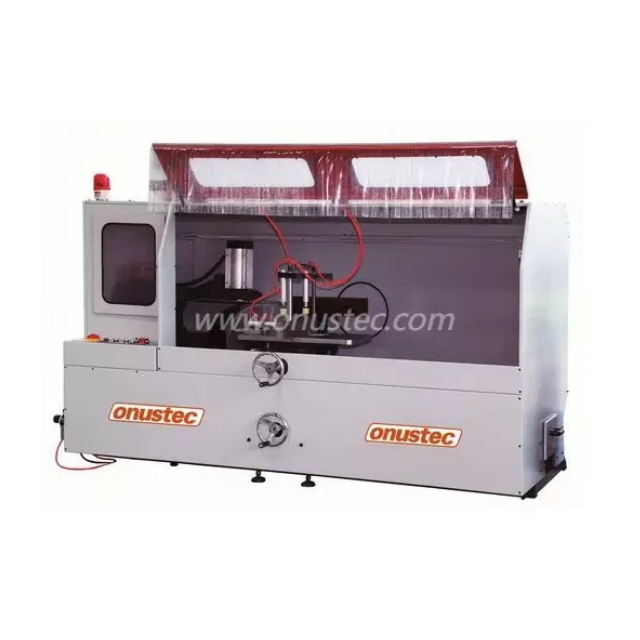
To fully realize the benefits of cast iron, careful manufacturing and heat treatment are essential. Casting inherently introduces residual stresses, which can distort machine accuracy if not addressed. Onustec Group applies controlled annealing and stress relief techniques to reduce internal tension and stabilize the material. This ensures that every column, base, and bridge retains dimensional integrity before precision machining, providing a stable foundation for the machine.
Advanced stress-relief methods, including furnace annealing and slow-cooling cycles, are used to achieve uniform microstructure and minimize internal stress gradients. This process is particularly important for large castings, where uneven cooling could otherwise lead to warping or cracking. The result is a machine that maintains high precision even during extended operation or under heavy cutting loads.
Once stress-relieved, cast iron components undergo high-precision machining to achieve the required tolerances. Critical features, such as spindle bores, linear guideways, and mounting surfaces, are milled, bored, and ground using advanced CNC machining techniques. At Onustec, precision inspection tools measure surface flatness, perpendicularity, and parallelism to ensure compliance with design specifications. Proper machining allows the cast iron structure to maximize its damping and thermal properties, ensuring repeatable accuracy and reliable performance for every production run.
Cast iron’s inherent properties extend the operational life of CNC vertical machining centers. Unlike welded steel frames, which may warp over time, or polymer composites that can degrade under heat or moisture, cast iron maintains geometric integrity for decades. This longevity ensures that parts remain within specification for years, reducing the frequency of recalibration and inspection cycles. For high-value manufacturing, this reliability is a decisive factor in maintaining consistent quality and reducing operational risk.
Another advantage lies in the ease of refurbishment. Cast iron components can often be re-machined or resurfaced without compromising structural integrity. Guideways, mounting surfaces, and other critical areas can be renewed, extending the machine’s life and reducing the total cost of ownership. This feature is particularly relevant for industrial workshops and production lines that require continuous uptime and cost-effective maintenance strategies. By retaining its structural properties, cast iron contributes to sustainable manufacturing practices while supporting long-term production efficiency.
The characteristics of cast iron make it ideal for demanding vertical machining operations. Applications such as mold making, aerospace components, automotive parts, and precision tooling all benefit from the damping and thermal stability inherent to cast iron structures. Heavy-duty cutting, high-speed milling, and operations requiring tight tolerances rely on the rigidity and vibration resistance of cast iron bases and columns. Additionally, its ability to handle uneven cutting forces without permanent deformation allows engineers to execute complex machining strategies with confidence.
At Onustec Group, every cast iron cnc vertical machining center is designed to handle both high-precision small parts and large, heavy workpieces. This versatility ensures that our machines meet the needs of diverse industries while delivering long-term stability and accuracy.
At Onustec Group, our high-end vertical machining centers are built with cast iron bases, columns, and critical structural components. Every casting undergoes strict quality control, from metallurgical composition to stress-relief treatment, ensuring consistent performance and durability. The integration of German engineering expertise guarantees that each machine leverages the natural strengths of cast iron while incorporating modern design improvements, such as optimized ribbing and weight distribution. The result is a vertical machining center that provides unmatched precision, vibration damping, and thermal stability for all production environments.
Cast iron remains the cornerstone of precision CNC vertical machining centers, offering unmatched vibration damping, thermal stability, and long-term reliability. At Onustec Group, we continue to harness the material’s unique properties, combined with German-engineered processes, to produce machines that maintain precision and productivity over their entire lifecycle. For manufacturers seeking durable and high-performance vertical machining solutions, understanding the advantages of cast iron is essential. Explore our range of high-precision VMCs and experience the difference of cast iron machine structures. Contact us today to learn more about our solutions and discuss your specific production requirements.
1. Why is cast iron preferred for CNC vertical machining centers?
Cast iron offers superior vibration damping, thermal stability, and long-term dimensional accuracy, making it ideal for precision machining.
2. How does cast iron compare to welded steel in CNC machines?
While welded steel has high strength, it lacks damping and thermal stability, which can lead to increased vibration and reduced precision.
3. What heat treatments are applied to cast iron machine components?
Controlled annealing and stress-relief processes stabilize castings and reduce internal stresses, ensuring long-term dimensional accuracy.
4. Can cast iron CNC machines be refurbished?
Yes, cast iron components can be re-machined or resurfaced, extending machine life and maintaining performance for many years.

