
Views: 0 Author: Site Editor Publish Time: 2026-10-10 Origin: Site


Manufacturing facilities constantly face a tough procurement reality today. You must balance the high production demands of aluminum extrusions against strict capital equipment budgets. Achieving maximum output without overspending remains a daily challenge for production managers. Complex aerospace machining discussions often favor sophisticated 4-axis and 5-axis machines. However, the 3-axis configuration remains the absolute backbone of linear profile machining. It delivers an unmatched cost-to-output ratio for single-face operations.
This guide provides an evidence-based framework for evaluating and shortlisting milling equipment. We will help you implement a reliable 3 axis aluminum profile cnc milling machine without falling for superficial vendor claims. You will learn how to match machine specifications directly to your production bottlenecks. Making the right choice protects your capital investment immediately. It also ensures consistent part quality across long production runs. Let us explore the core requirements for high-speed aluminum processing.
Application Boundary: 3-axis systems are highly profitable for single-face operations (drilling, slotting, tapping) on linear aluminum profiles but require manual repositioning for multi-face machining.
Core Spec Focus: Aluminum requires high spindle speeds (12,000–24,000 RPM) and aggressive chip evacuation to prevent chip welding; rigidity takes a backseat to RPM compared to steel machining.
Total Cost of Ownership (TCO): True costs extend beyond the sticker price, heavily factoring in X-axis length footprints, pneumatic workholding setups, and operator training for custom extrusions.
Vendor Shortlisting: A reliable supplier must provide verifiable time-studies and test-cut data on your specific alloy (e.g., 6061 vs. 7075), not just generic rapid traverse specs.
You must carefully evaluate the cost-capability tradeoff before purchasing new equipment. Compare the capital expenditure of a 3-Axis Aluminium CNC Profile Machining Center against 4-axis or 5-axis alternatives. Extra axes cost significant money upfront. They also add mechanical complexity to your daily operations. Paying for unused axes degrades your return on investment quickly. A 3-axis system excels when you process linear profiles requiring operations on a single plane.
Assess your current production delays carefully to identify true bottlenecks. Do manual layout processes slow down your assembly team? Are your current routers underpowered for heavy daily use? Do multi-setup operations cause persistent inaccuracies? Identifying these pain points helps justify the equipment upgrade. Replacing manual drilling stations or slow routers yields immediate productivity gains.
You must define clear success criteria before proceeding to vendor selection. A successful implementation relies on measurable performance indicators. Consider targeting specific operational improvements on your floor:
Achieve a 40% reduction in overall cycle time per extrusion.
Eliminate secondary deburring operations entirely through optimized cutting parameters.
Maintain sub-0.1mm repeatability over continuous 3-meter profile lengths.
Reduce scrap rates caused by manual measurement errors.
We must also acknowledge inherent machine limitations regarding complex geometries. Does your primary profile require continuous multi-sided contouring? If so, a 3-axis machine will introduce unacceptable manual handling errors. Operators must manually flip parts for secondary operations. This manual repositioning destroys tight tolerances and increases labor costs. Choose a 3-axis machine only if single-setup processing covers most of your catalog.
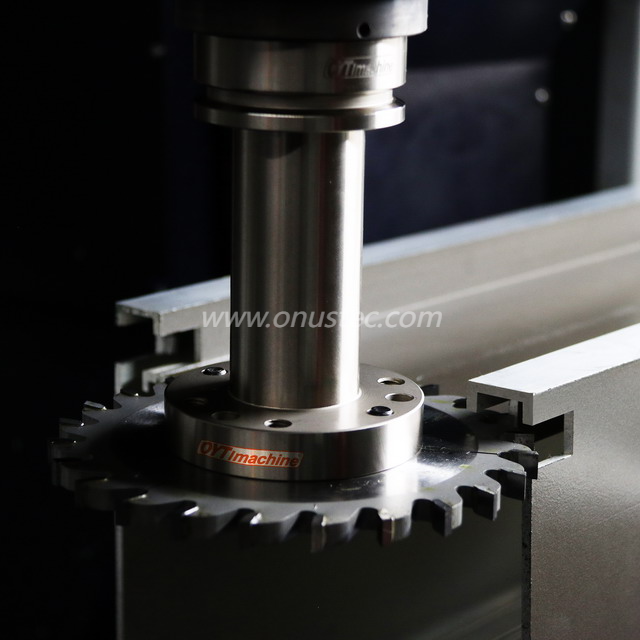
Certain industries benefit immensely from specialized linear profile processing equipment. Architectural and facade systems represent a massive market for these machines. Curtain walls, window frames, and structural glazing profiles demand high precision. They require rapid slotting and accurate hinge preparations. A 3-axis setup processes these long extrusions effortlessly. You achieve perfect alignment for complex architectural assemblies.
Transportation and electric vehicle (EV) manufacturing also rely heavily on extruded aluminum. Engineers design battery enclosures using lightweight structural components. Chassis components and rail transit interiors demand strict linear tolerances. Linear length processing capabilities make 3-axis machines ideal for EV suppliers. You can maintain strict quality control over massive production batches.
Industrial automation framing represents another highly profitable application sector. Factories worldwide utilize T-slot aluminum profiles for custom structures. Conveyor system guides and custom machine guarding require countless drilled holes and tapped threads. Processing Bosch Rexroth style profiles requires high-speed tapping and precision drilling. The automated nature of a 3-axis center eliminates tedious manual hole placement.
You must clearly understand out-of-scope operations to prevent costly machine damage. Do not attempt deep-cavity 3D mold making on these specific machines. Avoid heavy roughing of solid titanium or steel blocks entirely. These heavy-duty tasks require high-torque spindles and massive cast-iron frames. Misusing your profile machining center leads to premature spindle failure and voided warranties.
Aluminum acts very differently than steel during the machining process. Explain spindle dynamics carefully to your procurement team. Aluminum needs high RPM rather than high torque to achieve clean cuts. You need spindle speeds ranging between 12,000 and 24,000 RPM. High speeds slice through the soft metal effortlessly. Precision collets become mandatory at these extreme velocities. ER32 or HSK63F collets handle high-frequency vibration effectively. Poor tool holding causes chatter, which immediately ruins your surface finish.
Chip evacuation and thermal management require your full attention. Aluminum is a gummy material under intense heat. Chips can easily weld themselves to your expensive end mills. We must evaluate cooling systems thoroughly.
Aluminum Machining Cooling Systems Comparison
Cooling Method | Chip Evacuation Efficiency | Thermal Control | Maintenance Level |
|---|---|---|---|
Flood Coolant | Excellent for deep pockets | Maximum cooling capacity | High (requires fluid management) |
Mist Lubrication (MQL) | Great for open profiles | Keeps heat in the chip | Low (cleaner workspace) |
Air Blast Only | Poor for gummy alloys | Minimal cooling | Very Low |
We recommend Minimum Quantity Lubrication (MQL) for most linear profile work. MQL prevents tool galling while keeping the machine bed relatively dry. Poor chip clearance inevitably leads to surface finish failure and broken tools.
Workholding presents unique challenges across long X-axes. Aluminum profiles require specialized clamping to prevent bowing. Standard vises cannot secure a 6-meter extrusion properly. Evaluate pneumatic vise systems carefully during your vendor demonstrations. Pneumatic clamps can be automatically or semi-automatically repositioned. This repositioning prevents profile distortion during aggressive machining cycles. Proper clamping ensures your dimensional accuracy remains intact end-to-end.
Assess frame rigidity versus gantry weight before making a final decision. Steel machining requires massive cast-iron beds to absorb low-frequency vibrations. Aluminum profile machining centers utilize a different structural philosophy. They often employ welded steel beds designed to absorb high-frequency vibrations. Engineers design the gantry to remain lightweight for rapid acceleration. Do not over-engineer the gantry weight, or you will sacrifice crucial processing speed.
Speed serves as the ultimate productivity multiplier in profile machining. However, you must unpack what "fast" actually means in manufacturing. Vendors aggressively market their rapid traverse rates to attract buyers. Rapid traverse dictates how fast the machine moves without cutting material. Actual cutting feed rates determine your true production cycle time. A machine boasting incredible rapid traverse might struggle during heavy slotting. Always prioritize cutting feed capabilities over empty-space movement speeds.
Integrating a 3-Axis Fast Aluminium CNC Profile Machining Center demands superior motor technology. Closed-loop AC servo motors are absolutely mandatory for maintaining accuracy at high speeds. They continuously verify the gantry position against the control software. These servos utilize absolute encoders to minimize the risk of lost steps. Stepper motors lack this feedback loop and lose position during aggressive moves. Avoid stepper-driven machines for long X-axis travels.
Tool change efficiency drastically impacts your daily throughput. High-volume profile work requires frequent transitions between drilling, tapping, and slotting tools. Compare linear automatic tool changers against carousel designs. Linear changers mounted directly on the gantry offer lightning-fast swaps. A 10-second tool change becomes a massive liability over hundreds of cycles. Demand tool change times under 5 seconds to maximize spindle uptime.
Software integration determines how smoothly your machine executes complex toolpaths. Premium control systems parse look-ahead G-code effortlessly. Look-ahead capabilities allow the controller to anticipate upcoming directional changes. Systems provided by Siemens, Fanuc, or high-end PC-based controllers excel here. They automatically decelerate the spindle entering sharp corners. This precise speed management prevents corner-gouging and extends your tool life significantly.
Integrating long machinery requires meticulous factory floor planning. Aluminum profile machines are notoriously long, often ranging from 3 to 7 meters. You cannot just measure the machine footprint itself. You must factor in substantial material handling zones around the equipment. Operators need ample clearance for safe loading and unloading procedures. Pallets of raw extrusions require staging areas near the machine bed. Failing to plan these zones causes massive logistical traffic jams.
Acknowledge the learning curve associated with new CNC technology. Moving your team from manual saws and drills requires proper training. Full CNC adoption demands CAM software proficiency from your programmers. Operators must understand custom work offsets to handle slight extrusion variations. Invest in comprehensive vendor training packages during the initial installation. Skimping on training leads to crashed spindles and frustrated floor workers.
Identify common maintenance vulnerabilities to keep your machine running smoothly. Fine aluminum dust acts like an abrasive powder on mechanical components. Linear guide rail contamination causes premature bearing failure. You must enforce strict daily cleaning schedules for all exposed rails. Pneumatic line leaks also plague high-vibration work environments. Check air pressure regulators weekly to ensure consistent clamping force. Teach operators proper spindle warm-up cycles to prevent premature bearing wear.
Execute a strict action plan before issuing any purchase order. Advise your procurement team to demand a physical Proof of Concept (PoC). Submit a standard 3-meter extrusion CAD file to your shortlisted vendors. Require them to perform a physical test cut on their demo machines. Verify the resulting cycle times and inspect the surface finish yourself. This tangible proof prevents costly surprises after the machine arrives on your floor.
A specialized 3-axis aluminum profile CNC milling machine maximizes ROI efficiently. It serves as an indispensable asset for linear, single-setup manufacturing. You achieve superior precision while drastically lowering your manual labor requirements. Upgrading from manual processing to automated milling transforms your production floor.
Align your purchase strictly with your actual profile geometry and required volume. Do not over-index on raw speed specifications or unnecessary extra axes. Let facility constraints and realistic operator capabilities guide your final decision matrix. Smart procurement focuses on solving immediate bottlenecks rather than chasing theoretical capabilities.
Audit your current profile processing times immediately to establish a baseline. Consult directly with experienced tooling engineers regarding your specific aluminum alloys. Spec out the exact spindle speeds and pneumatic clamping requirements you need. Take decisive action today to secure a more profitable manufacturing future.
A: Generally, no. Engineers design these machines with high-RPM, low-torque spindles optimized specifically for soft metals. Machining steel requires massive torque and extreme structural rigidity. Using these high-speed machines on steel risks catastrophic spindle failure. You will also compromise the gantry geometry over time. Always use the proper machine for your chosen material.
A: X-axis travels typically range from 3 meters to 7 meters on standard configurations. For longer extrusions, you need machines featuring pass-through capability. You can also utilize specialized repositioning software. However, sliding long profiles through the machine often compromises strict positional tolerances. Plan your investment around your most common extrusion lengths.
A: You must manage heat and chip clearance perfectly. Utilize single-flute or two-flute polished carbide end mills for maximum flute space. Maintain aggressive feed rates to force heat into the chip rather than the tool. Implement a high-quality Minimum Quantity Lubrication (MQL) system to prevent galling.
A: During the active cutting cycle, no. The machine operates autonomously. However, loading and unloading long extrusions requires manual intervention. Operators must also clear chips between heavy cycles. You can automate loading with bar-feeding robotics, but this significantly alters your required factory floor footprint.


