
Views: 0 Author: Onustec Publish Time: 2026-10-22 Origin: Site


Aluminum demands specific cutting conditions. Its unique thermal properties require rapid heat dissipation to prevent melting. Standard woodworking machines fail completely under these industrial stresses. They lack proper chip clearing and structural resonance control for heavy-duty metalworking. You face a critical decision for your production line. You must choose between a panel router and a profile machining center. This choice rarely depends on raw spindle power alone. Instead, you must base it on material geometry, part holding methods, and your daily production bottlenecks. This guide gives you an objective, engineering-focused framework. We look at real-world implementation realities rather than simple manufacturer spec sheets. You will learn exactly how to evaluate machine architectures. We will help you optimize your specific shop floor operations and avoid costly production mistakes.
Material geometry dictates the machine: Flat sheet nesting requires the vacuum-table architecture of a panel router, while long extrusions require the dedicated clamping and multi-sided access of a profile center.
Axis configurations drive ROI: A standard 3-axis setup is cost-effective for 2D profiles, but multi-sided extrusion work demands 4-axis or 5-axis capabilities to avoid costly manual repositioning.
Rigidity and lubrication are non-negotiable: Regardless of the machine type chosen, high-speed aluminum cnc routing requires mass (vibration damping) and reliable MQL (Minimum Quantity Lubrication) to prevent chip welding and tool failure.
Start by assessing the material stock. You must map out your primary material inputs carefully. Are you cutting thin ACM (Aluminum Composite Material) panels? Perhaps you process solid 6061-T6 aluminum sheets. You might instead handle long architectural 6063-T5 extrusions. Geometry dictates your entire workflow. Panel routers handle flat stock beautifully. Profile centers tackle long, structural shapes. We recommend conducting a full material audit before proceeding. You cannot force a flatbed machine to hold an awkward L-bracket efficiently.
Next, identify cycle-time bottlenecks. We often see shops blame cutting speed for production delays. However, the real delay usually stems from part handling. Loading and unloading material consumes valuable operator hours. Secondary operations like tapping and side-drilling also eat up massive amounts of time. You must observe your operators directly. Watch them move parts between different workstations. Every manual touchpoint adds to your total cycle time. Eliminating these touchpoints should guide your equipment choice entirely. If operators constantly flip parts to drill side holes, your overall process suffers greatly.
You must address tolerance realities immediately. We must establish realistic expectations for part finish and dimensional accuracy. Routing differs significantly from traditional CNC milling. Milling offers higher rigidity for aerospace-grade precision. Routing provides speed and large-format versatility. You cannot expect micron-level accuracy from a standard gantry router. Thermal expansion alone shifts large aluminum sheets during cutting. You should aim for tolerances around ±0.1mm for standard routing tasks. Plan your assembly tolerances around these practical limits.
Best Practice: Use statistical process control to track your current tolerance deviations daily.
Common Mistake: Buying a high-speed router while expecting the rigid precision of a cast-iron milling center.
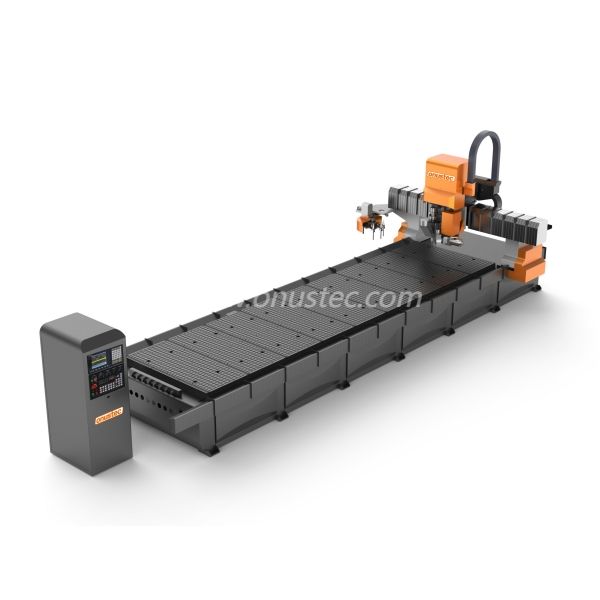
Core Architecture. A panel router utilizes a specialized vacuum hold-down system. It features a gantry design optimized for large, flat stock. This architecture holds thin sheets absolutely flat against the table. A rotary vane pump pulls vacuum through a porous MDF spoilboard. The MDF distributes the vacuum evenly across the entire sheet. The wide gantry spans the entire material width. It distributes cutting forces evenly across the massive bed.
Ideal Applications. You will want this setup for high-volume nesting. It processes aluminum composite materials perfectly. We also see it used heavily for aerospace panels and marine decking. These industries require massive flat patterns. Operators load full 4x8 or 5x10 sheets onto the spoilboard. The machine rapidly profiles multiple parts from a single sheet. This nesting process minimizes material waste significantly. Operators can also perform precise V-grooving for architectural folding applications.
System Integration. Implementing a 3-Axis CNC Router Machining Center for Aluminum brings specific operational benefits. We evaluate its capabilities based on daily production demands.
Strengths: You achieve high throughput for nested 2D and 2.5D parts. CAM programming remains straightforward. Operators learn 3-axis software quickly. You also benefit from a lower baseline capital expenditure.
Weaknesses: You will face poor capability for side-machining. Holding long, narrow extrusions on a vacuum bed causes massive issues. They become highly prone to vibration and part movement. This vibration causes poor edge finish and rapid tool wear.
Core Architecture. Profile centers feature a heavy-duty structural frame. They rely on adjustable pneumatic vise clamping instead of vacuum pressure. They offer an extended X-axis, often spanning 3 to 9 meters. Manufacturers design these specifically for handling long extrusions. The open design allows continuous loading of massive lengths. The pneumatic clamps adjust to grip complex internal webs securely.
Ideal Applications. These machines excel at curtain walls and automotive structural components. They handle window and door frames efficiently. You also use them for industrial T-slot profiles. These industries require precise holes and slots along long structural members. A vacuum table simply cannot secure these geometric shapes. Curtain wall fabrication requires weeping holes, lock cutouts, and hinge prep. These features demand direct side access from the spindle.
Advanced Configurations. A massive operational shift happens when you upgrade. Consider moving to a 4-Axis Twin-Spindle Aluminum Panel CNC Router Machining Center. This configuration fundamentally changes your production speed. The twin-spindle setup allows concurrent operations and rapid tool deployment.
Superior Clamping: Pneumatic vises adapt to the specific profile shape. They grip the material firmly without crushing hollow sections.
Multi-Face Access: The spindle rotates to access three or four sides. Operators do not need to unclamp the part manually.
Integrated Operations: You can drill, rout, and tap in one single setup. This eliminates secondary machining stations entirely.
Strengths: You gain massive time savings from single-setup machining. You get superior rigidity for thick-walled profiles. The clamps eliminate vibration completely. Weaknesses: They remain completely unsuitable for processing standard sheet goods. You face higher CAM software complexity. They require a significant physical footprint in your shop.
We must evaluate specific mechanical features objectively. We look at how they translate into daily production outcomes.
Part Fixturing & Hold-Down. We must compare vacuum matrix tables against adjustable pneumatic clamps. Vacuum tables require MDF spoiling boards. You also must perform strict CFM (Cubic Feet per Minute) calculations. If you lose vacuum pressure, parts will fly off the table violently. You must zone your table carefully to match the material size. This prevents massive air leaks around the edges. Pneumatic clamps require custom jaw planning. You must support the internal webbing of extrusions to prevent crushing.
Spindle Speeds & Torque Curve. You must evaluate spindle RPM carefully. Speeds exceeding 24,000 RPM work best for thin-sheet routing. High RPMs evacuate small chips quickly. Conversely, you need high-torque, lower-RPM spindles for heavy work. They handle tapping operations perfectly. They also process heavy wall extrusions much better. High torque prevents the spindle from stalling during aggressive cuts.
Tooling & Chip Management. Effective aluminum cnc routing demands pristine chip management. Mist cooling, known as MQL, serves as the industry standard. You face severe risks with inadequate lubrication. Galling occurs when hot aluminum welds to the cutter. Tool breakage happens rapidly afterward. Dust collection shrouds work wonderfully for panel routers. They suck chips up vertically. Gravity and conveyor chip extraction suit profile centers better. Chips fall naturally into bins below the clamps.
Table: Machine Architecture Comparison
Evaluation Metric | Panel Router System | Profile Machining Center |
|---|---|---|
Primary Part Fixturing | Vacuum Matrix Table (Zoned) | Adjustable Pneumatic Clamps |
Optimal Stock Material | Flat Sheets (ACM, 6061 Plate) | Long Extrusions (6063 Profiles) |
Side Machining Capability | Requires manual part flipping | Automated via 4-axis spindle |
Chip Extraction Method | Overhead dust collection hood | Gravity conveyor extraction bed |
You must plan for operational hurdles. We see many shops struggle during the initial transition. Proper planning mitigates these severe disruptions.
CAM Software & Operator Training. Transitioning from 3-axis nesting software poses serious challenges. Moving to 4-axis profile machining software creates a steep learning curve. Operators must visualize toolpaths in three dimensions. They must program safe collision-avoidance zones carefully. Operators often experience temporary productivity dips. You must budget adequate time for proper training. Moving from flat 2D DXF nesting to 3D STEP file programming requires entirely new skills.
Facility Requirements. You must address floor space immediately. Profile centers require massive linear footprints. A 9-meter machine demands substantial clearance for loading. You need enough room to maneuver long raw material safely. Compressed air volume remains critical. Both vacuum pumps and mist coolants consume heavy air continuously. Ensure your shop compressor can handle the massive CFM draw. Electrical load often necessitates facility upgrades. High-horsepower spindles draw massive amperage during aggressive cuts.
Maintenance Realities. Wear-and-tear differs greatly between the two systems. Panel routers require constant vacuum pump maintenance. You must change filters and check seals weekly. Spoilboards require frequent resurfacing to maintain a flat datum plane. Profile centers demand linear guide and clamp maintenance. You must clear chips from guides daily. Pneumatic cylinders require clean, dry air. Moisture in your airlines will cause internal rusting and clamp failure.
We can summarize the shortlisting logic simply. You must evaluate your primary production volume rigorously. If 80% of your operations involve flat sheets, choose the panel router. Default to a heavily optioned panel router equipped with dedicated aluminum routing bits. If you handle long extrusions regularly, pivot to the other path. If you require multi-face machining, a profile center offers the only viable path to scale.
Consider these action-oriented next steps:
Audit your production line to identify exact cycle-time bottlenecks.
Compile a comprehensive portfolio of your most common part geometries.
Recommend running a test part program (Time Study) with the machine manufacturer using your exact material grade before issuing a PO.
Upgrade your shop air compressor if you plan to utilize continuous MQL mist systems.
A: You should avoid modifying standard wood routers for metal. Aluminum requires high structural rigidity and specialized spindle torque. Cutting metal demands a robust mist cooling system. Hybridizing light-duty machines for continuous aluminum production causes severe vibration. You will experience poor edge finishes and rapid tool failure.
A: A 3-axis machine uses strict top-down XYZ movement. It works perfectly for flat sheets. A 4-axis machine features an indexable rotational cutting spindle. This allows the tool to rotate and access multiple sides of a profile. It eliminates manual part repositioning during extrusion machining.
A: You must focus on precise feed-and-speed calculations. Incorrect chip loads generate excessive heat. Use specialized O-flute tooling geometry to clear chips rapidly. Mandatory mist lubrication (MQL) prevents the material from galling. Proper coolant stops aluminum from melting and sticking to your cutters.


