
Views: 0 Author: Site Editor Publish Time: 2026-10-29 Origin: Site


Modern facade manufacturing operates on razor-thin margins and demands zero tolerance for joint gaps. Fabricators face mounting pressure as architectural designs incorporate increasingly large, complex, and heavy-duty extrusions. You need flawless precision on every single cut to maintain profitability. Standard saws quickly fail these rigorous curtain wall requirements. They lack the structural stability required for heavy profiles. They offer inadequate length capacity and struggle with imprecise angle positioning. You simply cannot build a high-performance commercial facade using basic window fabrication tools.
This guide provides a technical evaluation framework for selecting a specialized aluminum cutting machine. You will learn how to match saw length, angle range, and automation levels to your exact fabrication needs. We will help you align mechanical capabilities with current production throughput while planning for future scaling ambitions. By understanding these technical pillars, you avoid costly equipment mismatch and ensure seamless shop floor operations.
Curtain wall extrusion profiles dictate machine size: 5-meter to 6-meter cutting lengths are standard, but custom oversized profiles require scalable bed extensions.
Multi-angle flexibility (ranging from 22.5° to 135°) separates basic fabrication from high-end architectural facade execution.
Automation should map to production volume; upgrading from a 3-axis to a 7-axis CNC system dramatically reduces setup times and human error on complex mitre cuts.
Software integration (ERP and cut-list optimization) is as critical as mechanical reliability for preventing material waste.
Poor cuts in curtain wall fabrication create cascading failures across a project. Material waste on expensive thermal-break profiles destroys profit margins instantly. Inaccurate mullion and transom joints cause immediate site-installation delays. Worse, bad angles lead to failed weather seals, which eventually cause costly building leaks. You must treat every cut as a critical structural step. A fraction of a millimeter off at the base translates to a massive gap at the top of a multi-story elevation.
Curtain wall profiles behave very differently than standard window or door extrusions. They are heavier, thicker, and geometrically more rigid. These material realities demand significantly higher motor power from your equipment. You also need superior blade damping to prevent blade deflection during heavy-duty cutting cycles. A standard aluminum cutting machine often lacks the heavy-duty clamping pressure needed to hold these massive extrusions steady. If the profile moves even slightly during the blade stroke, the cut fails.
We evaluate procurement through three primary pillars. First, consider the physical footprint, specifically the maximum cutting length. Second, assess cutting versatility through angle range and positioning accuracy. Finally, review operational efficiency, which maps directly to your automation level. Integrating specialized Facade Curtain Wall Machines ensures you meet all three criteria effectively. By benchmarking against these pillars, you protect your capital investment and guarantee shop floor capability.
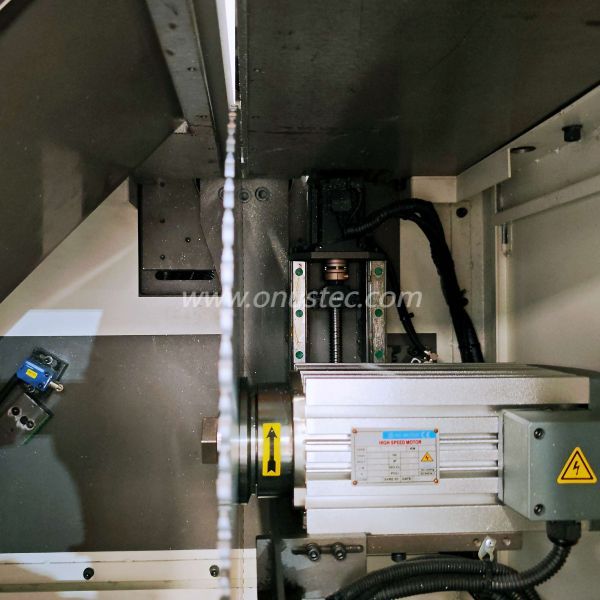
Raw aluminum extrusion lengths dictate your minimum usable cutting bed. Standard commercial extrusions typically arrive from the mill in 5.8m to 6.5m lengths. Your machine must handle these dimensions comfortably to maximize material yield. If you process custom oversized profiles for special architectural projects, your machine size requirements increase immediately. You cannot afford to overhang heavy materials off the end of a short bed safely.
Capacity planning requires a hard look at your typical project mix. You must choose the right foundational size to prevent production bottlenecks. Consider these standard industry tiers when planning your layout:
4-Meter Models: Best suited for smaller, segmented facade panels. They work well for secondary structural elements or smaller commercial storefronts.
5-Meter Models: The accepted industry baseline. They handle the vast majority of standard commercial transom and mullion requirements efficiently.
6-Meter Models: Absolutely necessary for continuous full-length vertical mullions without splicing. They provide maximum flexibility for large-scale commercial towers.
Think about scalability before making a final decision. Your business will likely take on larger projects over time. You can select machines offering modular roller conveyors to support longer raw materials. Digital measuring stops also help accommodate future, larger-scale commercial jobs. This modular approach prevents the need for a full machine replacement when your business grows. You simply add extensions to your existing framework.
Beware of the hidden risks tied to undersized beds. Forcing a massive 6-meter extrusion onto a 4-meter machine causes intense operator fatigue. Your team faces the constant, dangerous double-handling of heavy materials. This physical strain ultimately compromises cutting accuracy. It also drastically increases safety hazards on the shop floor, as unbalanced profiles can tip or bind the saw blade unexpectedly.
Modern facade geometry pushes the limits of standard fabrication daily. Basic 90° and 45° cuts no longer cover the architectural demands of contemporary buildings. Energy-efficient designs often utilize faceted facades. Curved building envelopes require highly precise intermediate degrees to form a perfect polygon. You need a machine capable of producing complex corner joints seamlessly. If your saw cannot hit a 73.5° angle perfectly, you cannot build a modern curved curtain wall.
This reality brings us to the debate between pneumatic and CNC angle positioning. Basic pneumatic tilting systems lock into specific, fixed angles. They usually stop at 45°, 90°, and 135°. They work fine for standard rectangular grids but fail completely on custom architectural designs. The operator must manually adjust mechanical stops to achieve anything outside those three presets, inviting immense human error.
In contrast, fully servo-driven systems provide any-angle positioning. They smoothly cover wide ranges, typically from 22.5° to 157.5°. The servo motor drives the cutting head to the exact fractional degree commanded by the software. This multi-angle flexibility is non-negotiable for high-end architectural facade execution. It removes the guesswork and ensures repeatability across hundreds of identical cuts.
We must also evaluate single versus double mitre capabilities. Single head saws require operators to move the profile twice for a double-angled piece. This takes time and ruins accuracy. Double mitre saws cut both ends simultaneously. This simultaneous action mathematically eliminates cumulative measurement errors on large facade frames. It guarantees the final fabricated frame matches the original CAD model perfectly.
Feature | Pneumatic Fixed-Angle System | Servo-Driven CNC System |
|---|---|---|
Angle Flexibility | Limited (usually 45°, 90°, 135°) | Any angle (typically 22.5° to 157.5°) |
Setup Speed | Moderate manual mechanical adjustments | Instant software-driven servo positioning |
Architectural Target | Standard grid commercial facades | Complex, faceted, and curved building envelopes |
Accuracy Level | High for standard fixed mechanical stops | Ultra-high across all fractional degrees |
Your automation choices should map directly to your daily production volume. Over-investing burns capital unnecessarily, while under-investing severely kills productivity. You need a pragmatic approach to selecting how many motorized axes your shop truly needs. Each automated axis removes a manual operator step, speeding up the overall cycle time.
For strong baseline automation, consider a 3-Axis Multi-Angle Heavy-Duty CNC Automatic Saw. This equipment represents an excellent balance of capital cost and daily efficiency. It is best suited for high-volume, repeatable standard cuts. You get automatic length positioning (Axis 1) and reliable basic angle tilting on both heads (Axis 2 and 3). It handles standard production mixes beautifully without unnecessary software complexity. Your operators can learn to run it efficiently within days.
When project variance increases significantly, you need advanced automation. A 7-Axis Facade CNC Double Mitre Saw transforms how your shop operates entirely. It is perfect for premium architectural facades requiring complex compound angles. The 7-axis system features automated tilting, pivoting, and automatic profile height detection. You achieve complex zero-setup changeovers instantly. The machine reads the profile dimensions and adjusts its own clamping and blade stroke accordingly.
How should you framework this investment? Look closely at your production mix. Do not over-spec your equipment if 90% of your work consists of standard right-angle transoms. A robust 3-axis machine will maximize your throughput highly efficiently. However, you should invest heavily in a 7-axis setup if your shop handles custom, high-variance project work. The upfront axis investment pays off quickly by eliminating manual measurement errors and dramatically speeding up complex frame assemblies.
Mechanical reliability means absolutely nothing if your data transfer fails. Cut-list optimization serves as the brain of modern facade manufacturing. You cannot afford to run a modern shop floor using printed spreadsheets and tape measures. The risk of transposing numbers is simply too high when dealing with expensive aluminum materials.
You need seamless data transfer from design software directly to the machine. Popular facade design platforms like SchuCal, Orgadata, or AutoCAD must communicate with your saw via network or USB. This integration eliminates manual keypad entries. It prevents operators from misreading dimensions on printed shop drawings. The machine receives a .CSV or .NC file and executes the cutting sequence automatically.
Integrated software aggressively minimizes offcuts. Optimized nesting routines calculate the best cutting order to squeeze the maximum yield out of every raw aluminum bar. This material yield improvement directly impacts your bottom line. Saving just five percent on material waste yields massive savings when cutting expensive thermally broken curtain wall profiles.
Hardware features must also align with strict safety and operational compliance standards. A high-performance saw must protect both the operator and the shop environment. Look for these essential components:
Fully Enclosed Cutting Zones: Heavy-duty hoods protect operators from high-speed aluminum chips and catastrophic blade binds. The machine should not run if the hood remains open.
Micro-Lubrication Systems (MQL): These systems spray a fine mist of oil directly onto the blade teeth. They extend blade longevity while keeping the work environment clean and free of flood coolant.
Phase-Sequence Protection: This electrical safeguard prevents severe servo motor damage from improper factory wiring setups.
Finally, always evaluate realistic maintenance assumptions before purchasing. Check the local availability of service technicians in your region. Investigate the spare parts supply chain carefully. Ensure you can quickly source replacement servo motors or specialized 500mm to 600mm facade blades. Remote diagnostic capabilities also offer a massive advantage. They allow machine manufacturers to log in via Wi-Fi to troubleshoot software issues without requiring a costly site visit.
Selecting the right cutting equipment requires a highly disciplined approach. You must map your saw length to your maximum raw material dimensions. You must align your required angle range with your typical architectural complexity. Finally, you must match the automation level directly to your labor availability and throughput targets. Following this structured logic ensures you acquire a machine that genuinely performs under pressure.
Do not buy equipment based solely on a brochure. Before finalizing any purchase order, take proactive verification steps. Request thorough time-studies from the manufacturer. Demand test-cuts using your own heaviest, most complex profile extrusions. Seeing the machine handle your actual materials is the only accurate way to verify clamping pressure and blade damping. Make your final decision based on proven, real-world shop floor evidence.
A: You generally need a 5-meter to 6-meter cutting length. This size handles standard raw extrusions (typically arriving in 5.8m to 6.5m lengths) highly efficiently. A bed of this size allows you to process full-length vertical mullions with minimal offcut waste. It also prevents the dangerous, labor-intensive double-handling of heavy materials on the shop floor.
A: No, standard window saws lack the necessary robust construction. Curtain wall profiles require significantly higher motor power to prevent stalling during cuts. They also require much larger blade diameters—typically 500mm to 600mm—and far greater pneumatic clamping pressure to hold the rigid, heavy extrusions securely.
A: A 7-axis CNC system completely eliminates manual measuring and the need for test cuts. Software-driven automated positioning ensures the blade hits the exact mathematical angle and length every time. This precision drastically reduces scrap pieces, preventing expensive material waste caused by human setup errors or misread tape measures.


