
Views: 0 Author: Site Editor Publish Time: 2026-08-24 Origin: Site


For manufacturers facing the pressure of high-volume production, the cutting station often becomes the primary bottleneck. Standard single-head saws simply cannot keep pace with the demands of modern window wall fabrication or industrial profile manufacturing. The need to measure, cut, rotate, measure again, and cut the second end essentially halves your potential throughput. This operational friction drives forward-thinking facility managers to invest in a CNC Double Mitre Saw. By cutting both ends of a profile simultaneously with high precision, you transform a sluggish manual process into a streamlined automated workflow.
However, sourcing this machinery presents a significant dilemma. The market is fragmented and opaque. Buyers often find themselves navigating a difficult choice between ordering factory-direct new machinery, which involves high capital expenditure (CAPEX) and long lead times, or gambling on the used market. The used market offers speed and savings but comes with risks regarding machine condition, controller obsolescence, and software compatibility. A 15-year-old machine might look mechanically sound but could be electronically dead if the control software is unsupported.
This guide moves beyond simple equipment listings. We evaluate the top sourcing channels, define technical vetting criteria, and analyze ROI factors for acquiring high-end cutting machinery. Whether you are in window fabrication, picture framing, or industrial manufacturing, this article provides the framework to secure the right equipment without falling victim to costly pitfalls.
Efficiency Multiplier: Switching from single to double mitre saws typically reduces handling time by 40–50%, justifying the higher initial CAPEX.
Market Segmentation: Sourcing channels differ drastically by industry; Machinio and Ex-Factory dominate heavy industrial (fenestration) listings, while dealers like AIM Equipment specialize in precision framing.
Used Market Reality: Pre-owned industrial CNC saws average between $5,500 and $16,500 depending on age and control sophistication; verifying CNC controller software support is the critical kill criteria for used units.
Brand Tiers: Distinguish between heavy-duty fenestration brands (Elumatec, Emmegi) and precision joining brands (Pistorius, Cassese).
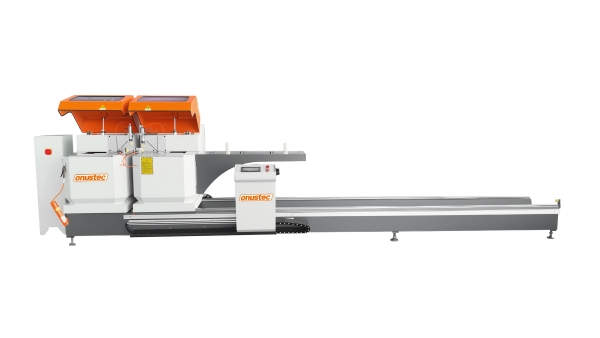
Defining this equipment requires looking past the mechanics to the output capability. A basic miter saw cuts angles; a double miter saw acts as a production multiplier. Specifically, a CNC Double Mitre Saw is defined by its ability to execute precise angled or miter cuts on two ends of a workpiece simultaneously. This action is controlled by digital cut lists, ensuring that every cut minimizes waste and adheres to strict tolerances.
If your daily production involves hundreds of identical or variable-length cuts, the manual adjustment of stops is no longer viable. You need an Automatic Double Mitre Saw to handle the data and the physical movement. These machines shine in specific core scenarios:
Window & Door Fabrication: This is the dominant sector for these machines. Fabricators require high-volume cutting of aluminum and vinyl profiles (fenestration) where 45-degree accuracy determines if the window frame will weld or join correctly.
Picture & Art Framing: Here, the focus is on the finish quality. Operators need precision 45-degree joining capability. If the corner accuracy drifts even slightly, the frame gap becomes visible, ruining the product.
Industrial Manufacturing: This includes batch processing of extruded materials for solar panel frames, furniture components, or lighting fixtures.
The transition from manual or pneumatic systems to fully automatic solutions changes your workflow logic. CNC integration allows your team to import batch files (CSV or XML) directly from the office. This bypasses the operator’s need to key in dimensions, significantly reducing human error. Furthermore, modern CNC controllers utilize nesting algorithms. These programs analyze the cut list and the raw bar length to determine the optimal cutting order, squeezing the maximum yield out of expensive aluminum or hardwood extrusions.
When browsing listings for a High End CNC Double Mitre Saw, generic specifications like good condition are insufficient. You must evaluate the machine based on strict technical metrics that align with your specific production geometry.
The physical limits of the machine dictate what contracts you can bid on. First, analyze the Rectangular Capacity. A standard framing saw might offer a 9-inch width capacity, which is adequate for wood mouldings. However, industrial applications often require 25-inch or greater capacities to handle wide fenestration profiles or curtain wall extrusions.
Second, verify the Length Capacity. Designs typically feature one fixed head and one moving head. You need to confirm if the bed length supports your maximum extrusion profile. If you process standard 20-foot aluminum extrusions but the machine bed is only 10 feet, you will need expensive feed extensions or a different machine entirely.
The controller is often the first component to become obsolete. When evaluating used options, distinguish between legacy and modern CNC systems.
Legacy Risks: Be wary of machines running on proprietary controllers from the 1990s or early 2000s. If these rely on floppy disks or serial connections (RS-232) for data transfer, integrating them into a modern network will be a nightmare.
Modern Connectivity: Ensure the machine supports USB or Ethernet transfer. This connectivity allows for real-time production tracking.
Software Compatibility: Ask explicitly if the machine integrates with your existing ERP or cut-list software, such as WindowMaker or FrameReady. A machine that cannot read your data files is just a manual saw with a fancy screen.
The motor specifications reveal the machine's intended purpose. A 2 HP motor suggests the unit was designed for light wood framing. In contrast, heavy aluminum extrusion processing requires 14 HP+ systems to maintain torque through thick walls without stalling. Additionally, inspect the movement precision. A High Precision Double Mitre Saw should utilize linear guides rather than simple rollers. Rack-and-pinion drives generally offer better longevity and accuracy over long bed lengths compared to belt-driven systems, which can stretch over time.
Finding the right machine involves knowing where to look. The market is segmented, and different channels offer varying levels of protection and service.
| Channel Type | Examples | Pros | Cons |
|---|---|---|---|
| Specialized Aggregators | Machinio, MachineSeeker, Surplus Record | Largest volume of listings; powerful filtering for specific specs and brands. | Acts as a lead generator, not a seller. Buyers must perform heavy due diligence on the actual seller. |
| Stocking Dealers | Ex-Factory, CNC Exchange, AIM Equipment Co. | Equipment is often cleaned and checked. Clear condition definitions (As-Is vs. Reconditioned). | Higher price premiums compared to direct liquidation or auctions. |
| Manufacturer Direct | Elumatec, Emmegi, FOM Industrie | Full warranty, installation, and training included. Access to latest tech. | Highest initial cost and potentially long lead times for new builds. |
Specialized Industrial Marketplaces like Machinio act as search engines for machinery. They are excellent for market research to understand price trends. However, because they aggregate listings from various brokers, the quality of information varies. You might find a listing for a generic saw next to a specialized industrial unit without clear distinction.
Dedicated Machinery Dealers provide a buffer of safety. Companies like Ex-Factory or AIM Equipment often physically inspect the machinery. They can tell you if a used machine is production-ready or a mechanic's special. For complex CNC equipment, this transparency is worth the premium.
Finally, going directly to a CNC Double Mitre Saw Manufacturer is the safest route for long-term reliability. Brands like Elumatec or Emmegi often have Certified Refurbished programs. While expensive, these units come with the assurance that the manufacturer supports the software and parts.
Not all double mitre saws are created equal. Manufacturers tend to specialize in specific material verticals, and crossing these lines can lead to poor performance.
In the window and door industry, rigidity is king. Key brands include Elumatec, Emmegi, FOM Industrie, and Italmac. These machines are engineered with high-torque motors and integrated coolant systems specifically for cutting metal. They often feature complex multi-axis CNC heads capable of compound angles required for modern architectural facades. If you are cutting thick-walled aluminum, these are the brands to target.
For framers, the priority is a chip-free finish. Brands like Pistorius, Cassese, Brevetti, and CTD dominate this space. Their clamping logic is designed to hold delicate wood mouldings without crushing them. The blade geometry and RPMs are tuned to leave a polished surface that requires no sanding before joining. These machines usually have a smaller footprint, fitting easily into a workshop environment.
Buyers often encounter a Multi Function Double Mitre Saw that claims to handle both wood and aluminum equally well. While tempting for versatility, there are trade-offs. These hybrids often compromise on blade speed (wood needs lower RPM than some metals to avoid burning, while aluminum needs specific speeds to clear chips). Additionally, the clamping rigidity required for aluminum might crush soft wood, while wood clamps might slip on metal. Be skeptical of "all-in-one" claims unless the machine features variable speed drives and adjustable pressure settings.
The purchase price is just the entry fee. The Total Cost of Ownership (TCO) determines the true value of the investment.
The Used Price Bracket: Market data suggests that functional used industrial units generally trade between $5,500 and $16,500. Machines priced below this range often lack CNC capabilities or have critical defects. Be aware that a cheap $3,000 unit might require a $5,000 retrofit to update the controller, destroying your savings.
TCO Drivers:
One often overlooked cost is Blade Maintenance. Double saws mean double the tooling costs. Sharpening 12 to 20 carbide blades is a recurring expense that affects your bottom line. Space is another factor; these machines have large footprints. Ensure your floor space calculations account for the swing of the heads and material infeed/outfeed. Finally, consider Implementation & Calibration. A used machine will likely lose its calibration during transport. Hiring a technician to recalibrate the heads to cut at perfect tolerance over a 12-foot span is a hidden cost that you must budget for.
ROI Calculation:
To justify the purchase, calculate ROI based on Cuts Per Minute and waste reduction. If a CNC saw utilizes nesting to save 10% of your aluminum stock compared to a manual operator, the material savings alone can pay for the machine financing in under two years. Speed is valuable, but material yield often drives the financial argument.
Buying used CNC equipment is risky. Protect your capital by following this strict verification checklist before wiring any funds.
The Power Up Verification: Never rely on static photos. Request a video of the machine powering up, homing its axes, and executing a simple program. You need to see the heads move and hear the motors run to rule out seized bearings or dead drives.
Controller Obsolescence: Check the HMI (Human Machine Interface). Is the screen legible? Are the buttons responsive? More importantly, verify if the manufacturer still sells replacement parts for that specific control unit. If the screen dies and parts are unavailable, the machine becomes scrap metal.
Pneumatic Integrity: Air leaks are dangerous and expensive. Listen for hissing in the video or inspect hoses in person. Leaking clamping cylinders can cause the material to slip during a cut, leading to inaccuracy and safety hazards.
Documentation: Insist on obtaining the original electrical schematics and parameter backups. If a used CNC machine loses its parameters due to a dead battery, having the backup disk or paper parameters is the difference between a simple restore and a weeks-long reprogramming nightmare.
Finding the right CNC Double Mitre Saw requires balancing material requirements, volume goals, and budget constraints. Whether you are cutting aluminum for skyscrapers or wood for gallery frames, the decision matrix remains the same: accuracy, speed, and supportability.
For high-production environments, the risk of downtime on an unsupported used machine outweighs the potential upfront savings. We recommend leaning toward reputable dealers like Ex-Factory or CNC Exchange, or seeking certified manufacturer refurbishment. Avoid As-Is auction listings unless you have an in-house maintenance team capable of rebuilding complex CNC systems. The goal is to buy a production solution, not a maintenance project.
A: A sliding compound miter saw has a single cutting head. The operator must cut one end, measure, slide the material, and cut the other end. A double miter saw has two heads that cut both ends of the profile simultaneously. This eliminates the intermediate handling and measuring steps, effectively doubling production speed and significantly improving length accuracy for batch processing.
A: Generally, no, unless specified. Wood saws typically run at lower RPMs and lack the necessary mist coolant systems required for cutting aluminum. Cutting aluminum on a wood saw without lubrication will ruin the blade and result in poor cut quality. However, some heavy-duty industrial saws are designed to handle both materials if equipped with variable speed motors and mist lubrication.
A: It depends on the electronics. Mechanically, older industrial saws from top brands like Elumatec are incredibly durable and can last decades. However, the CNC controller is the weak link. If the electronics are obsolete and unsupported, a minor board failure can render the machine useless. Only buy if the controller has been retrofitted or if you have confirmed support paths.
A: Most industrial double miter saws require a steady air supply of 90–100 PSI (6–7 bar) to operate the pneumatic clamps and head movement effectively. It is critical to have a compressor with sufficient CFM (cubic feet per minute) capacity to maintain this pressure during continuous cutting cycles to prevent clamps from loosening.


