
Views: 0 Author: Site Editor Publish Time: 2026-09-28 Origin: Site


Mastering cnc machining aluminum extrusions introduces specific physics challenges. Vibration, thermal expansion, and deflection quickly push standard equipment beyond its limits. Traditional vertical machining centers simply cannot handle these lengthy materials efficiently. They require manual index shifting. This destroys precise tolerances and extends cycle times. We know precision matters when you produce components for demanding industries. You need specialized equipment designed to control harmonics and thermal drift across extensive spans.
This guide provides an evidence-based framework for evaluating dedicated extrusion machining equipment. We cover critical applications like industrial automation, aerospace, and structural framing. You will learn the exact criteria needed to shortlist equipment based on rigidity and travel length. By matching proper spindle dynamics and workholding strategies, we help production managers optimize their manufacturing floor. You can secure operational efficiency, eliminate scrap, and maintain perfect geometric tolerances across long sections.
Standard VMCs are highly inefficient for profiles over 3 meters; dedicated CNC Profile Machining Centers eliminate the need for index shifting.
Spindle speed and torque must align with aluminum's specific cutting parameters to prevent chip welding and tool failure.
Workholding strategies are as critical as the machine itself—pneumatic, repositionable clamping is required to mitigate vibration over long spans.
Moving from 3-axis to a 4-Axis High-Precision Gantry CNC Profile Machining Center or 5-axis equivalent significantly reduces handling time for multi-sided operations.
We must first address the physical behavior of extruded materials. Extrusions are inherently hollow structures. They lack solid mass. Without proper equipment rigidity, you will encounter severe resonance and chatter. Harmonics generated during high-speed cutting lead to poor surface finishes. They also accelerate rapid tool wear. Standard mills cannot dampen these specific vibrations effectively.
Thermal expansion presents another major hurdle. Aluminum possesses a high coefficient of thermal expansion. Machining generates immense friction and heat. A long profile will measurably expand during heavy material removal. Machining continuous lengths requires strict coolant protocols. Dedicated extrusion machines actively compensate for thermal drift. If they fail to adjust, hole coordinates will shift out of tolerance across a long span.
Gravity introduces the challenge of deflection. Long hollow profiles naturally sag in the center. Evaluating how a machine bed supports material across spans of 3 to 18 meters remains a non-negotiable first step. Insufficient bed support guarantees bowed parts. You must evaluate the dynamic support capabilities beneath the cutting zone.
Many shops attempt a risky transition from hobbyist routers to industrial production. Lightweight gantry routers consistently fail under high-volume demands. They lack heavy cast mass. They feature insufficient servo torque. They cannot hold tight tolerances under sustained structural loads. Industrial production demands rigid frame architectures built specifically for heavy metal removal.
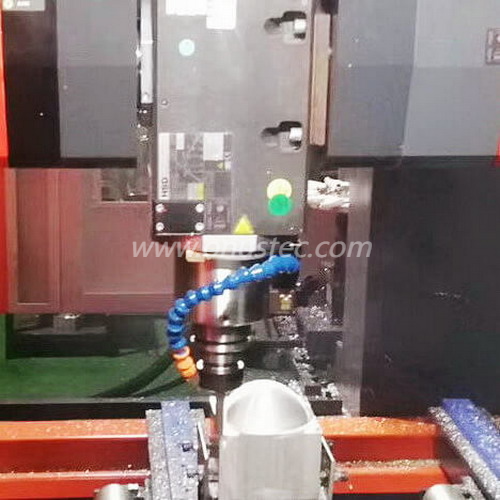
Choosing the correct machine architecture dictates your entire production flow. Different industries demand distinct operational capabilities. Standard long-bed 3-axis centers serve a specific, limited purpose. They work best for single-face operations. Simple drilling, tapping, and basic structural frames fit perfectly here. However, severe limitations exist. You must manually flip multi-sided extrusions. This manual intervention increases setup time. It also heavily introduces tolerance stacking risks. We advise against 3-axis setups for complex, multi-sided geometries.
Upgrading to a 4-Axis High-Precision Gantry CNC Profile Machining Center transforms complex workflows. Multi-sided machining occurs without unclamping the part. You can easily process the front, top, and back simultaneously. These machines excel in curtain wall manufacturing. They dominate automotive crash structure production and industrial automation framing. Eliminating secondary setups improves geometric true-position accuracy drastically. It reduces operator handling time and prevents alignment errors.
Aerospace and mass transit applications demand massive scale and complex articulation. These sectors rely on a 5-Axis 18m Large CNC Gantry Profile Machining Center. Railway structural beams and complex compound angles demand full 5-axis simultaneous interpolation. Evaluation requires strict engineering verification. You must check machine foundation requirements carefully. Volumetric accuracy compensation across the full 18-meter X-axis travel ensures perfect linear precision. These massive units represent the pinnacle of extrusion processing capability.
Audit your most complex extrusion profile before requesting quotes.
Measure the longest component you plan to produce over the next five years.
Avoid under-sizing your travel length to save initial capital.
Require standard test cuts demonstrating true-position accuracy.
Procurement engineers must look past basic brochures. Evaluating core internal components guarantees long-term success. Spindle specifications for aluminum differ greatly from steel machining. Aluminum demands speed, not brute force. High RPM spindles operating between 12,000 and 24,000 RPM perform best. Combine this speed with low-to-medium torque. Look specifically for HSK-63F or ISO30 tapers. They provide necessary balance at extreme speeds. Standard tapers suffer from runout and chatter under high centrifugal forces.
Gantry mass and drive systems dictate overall surface finish. Compare rack and pinion mechanisms against linear motors on the X-axis. Assess the structural weight of the moving gantry closely. Heavier cast iron absorbs harmonic vibration significantly better than fabricated steel. Polymer concrete beds offer even superior dampening characteristics. High mass prevents cutter resonance from echoing through thin extrusion walls.
Aluminum machining produces high volumes of stringy or granular chips. Aluminum melts easily under friction. It frequently sticks to the cutting tool. Evaluate the chip evacuation capabilities thoroughly. You need robust conveyor designs. Mist coolant recovery systems prevent jams along extensive machine beds. Minimum Quantity Lubrication (MQL) often outperforms traditional flood coolant on long gantries.
Software and control compatibility impact daily operations. The controller must process massive G-code files seamlessly. Extrusion profiling generates heavy code. Assess system integration capabilities early. Standard CAD/CAM software must connect to the machine controller without proprietary bottlenecks. Smooth data transfer ensures fast setup times.
Spindle Taper Comparison for Extrusion Processing
Taper Specification | RPM Capability | Vibration Dampening | Best Application Use |
|---|---|---|---|
CAT40 | Up to 12,000 RPM | Moderate | Heavy steel, slow cutting |
ISO30 | Up to 24,000 RPM | High | Light duty aluminum, routing |
HSK-63F | Up to 30,000 RPM | Exceptional | High-speed industrial extrusion milling |
Standard workholding methods routinely fail on long extrusions. Clamping hollow materials presents a unique physical challenge. Standard mechanical vises warp thin extrusion walls. Applying too much pressure crushes the internal webbing. Applying too little pressure causes the part to pull out during heavy cuts. Dedicated equipment solves this through intelligent fixturing design.
You must evaluate machines featuring pneumatic and servo-controlled clamps. These intelligent systems feature independent clamping zones. They automatically reposition themselves based on G-code commands. They slide horizontally to adapt to your specific extrusion geometry. This prevents collisions during multi-axis machining operations. Repositionable clamps secure the material firmly without inducing crushing force.
Dynamic support systems represent another critical feature. Gravity pulls downward on spans over three meters. Look for programmable pop-up supports. They rise underneath the material directly below the cutting zone. They prevent downward deflection during heavy plunging operations. Without dynamic support, drill bits will wander. True-position tolerances will fail across the middle of the extrusion.
Evaluate your jaw tooling strategies carefully. Universal jaws handle standard T-slots effectively. They adapt to simple square profiles easily. However, complex heatsinks and custom architectural shapes require different approaches. You will likely need custom machined soft jaws. Consider the time required to machine custom soft jaws for every unique profile. Standardizing your extrusion designs minimizes these custom tooling bottlenecks.
Using rigid mechanical vises on thin-walled sections.
Failing to support the center span of extrusions longer than four meters.
Ignoring clamp collision zones during 4-axis programming.
Clamping directly over unsupported hollow internal cavities.
Procuring specialized equipment introduces distinct facility challenges. High-precision long gantry machines require specialized infrastructure. A standard factory floor cannot support an 18-meter machine bed properly. You must pour isolated, reinforced concrete foundations. These specialized foundations prevent environmental vibrations from reaching the machine. They maintain absolute levelness over decades. Skipping foundation work destroys volumetric accuracy.
The operator adoption curve demands serious attention. Shifting from standard vertical mills to complex profile centers requires new skills. Operators must master advanced CAM programming. Simultaneous 4-axis and 5-axis movements require sophisticated toolpath generation. Collision avoidance becomes critical on long beds. Factor extensive training downtime into your initial rollout plan. We recommend partnering closely with the OEM for onsite operator certification.
Maintenance assumptions differ greatly on long-travel machinery. Verify your chosen OEM service level agreements carefully. Gantry alignment checks carry higher preventative maintenance demands. Spindle rebuilds occur more frequently due to continuous high-RPM operations. Linear guide lubrication systems must cover massive travel distances. Neglecting these lubrication systems leads to catastrophic rail failure. Establish strict, calendar-based preventative maintenance routines immediately upon installation.
Evaluating specialized extrusion equipment requires a strict focus on physical realities. The correct machine choice hinges on your maximum profile length and required cycle times. Selecting the proper multi-sided access dictates whether you need 3, 4, or 5-axis capabilities. Prioritize heavy gantry mass, high-RPM HSK spindles, and intelligent pneumatic workholding. These elements directly neutralize vibration and thermal expansion.
Your next step requires active verification. Request a physical test cut from the OEM using your most complex extrusion profile. Do not rely on standard demonstration materials. Mandate a Coordinate Measuring Machine (CMM) report on your finished test piece. Verify geometric true-position tolerances over the full material length. Taking these evidence-based steps guarantees you select the perfect machining center for your production floor.
A: Lightweight extrusions physically fit on standard tabletop routers. However, industrial machining requires a rigid spindle and proper T-slot workholding. Standard routers lack the mass to prevent chatter. You must use dedicated fixturing to prevent the thin walls of 2020 profiles from collapsing under cutting pressure.
A: A 4-axis center generates immense efficiency by reducing manual setups. You eliminate tolerance stacking errors when machining three sides of a profile in one single clamping operation. It prevents human alignment mistakes and drastically accelerates continuous production throughput on long materials.
A: Aluminum melts and welds to cutters easily. You must utilize Minimum Quantity Lubrication (MQL) or high-pressure flood coolant. Combine proper lubrication with high-polish, uncoated solid carbide tooling. Choose geometries specifically optimized for aluminum to ensure fast chip evacuation and cool cutting temperatures.


