
Views: 0 Author: Site Editor Publish Time: 2026-06-03 Origin: Site


High-volume fabrication of aluminum and PVC profiles requires more than just simple 45° or 90° cuts. Complex architectural designs, such as curtain walls, sunrooms, and automotive components, now demand compound angles that standard double mitre saws cannot handle efficiently. When you rely on basic machinery for these intricate tasks, you risk creating significant bottlenecks. These include manual rework for compound angles, material waste due to a lack of optimization, and frustrating software incompatibility.
The solution lies in upgrading to a 5-Axis CNC Double Mitre Saw. This technology acts as a bridge between high-speed cutoff saws and flexible machining centers. It offers automated compound angling on both heads simultaneously, streamlining your workflow. This article provides a transparent evaluation framework. It will help you select a machine that balances throughput, precision, and Total Cost of Ownership (TCO), ensuring your investment drives real growth.
5-Axis Definition: Unlike standard saws, a Multi Angle CNC Double Mitre Saw automates the blade tilt (bevel) and table rotation (mitre) on both heads independently, plus the X-axis linear movement.
Drive Matters: Prioritize Servo Driven motion over pneumatic systems for repeatability and complex compound angle accuracy.
Software is Critical: The hardware is only as good as its integration with your optimization software (Cut Lists/BOMs).
Cut Type Physics: "Up-cut" vs. "Back-cut" mechanics dictate which profile sizes and shapes you can process safely.
Hidden Costs: Factor in tooling, post-processor development, and calibration equipment, not just the machine price.
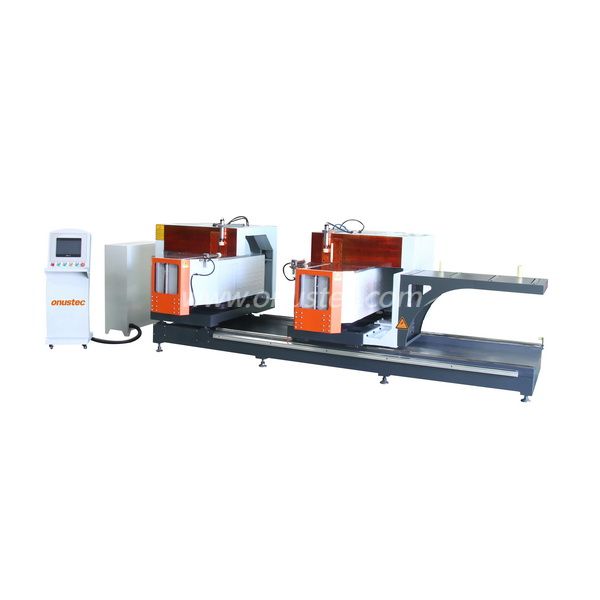
Before evaluating specific machinery, we must determine if your production volume and complexity justify the investment in 5-axis technology. Many workshop owners confuse standard automation with true multi-axis flexibility. Understanding this gap is the first step toward a profitable decision.
Standard 3-axis machines serve a specific purpose. They automate the length positioning (X-axis) and often the mitre angle (Y-axis) of the cutting heads. However, the tilt (Z-axis or A-axis) usually remains a manual operation. If your production line primarily churns out basic window frames with standard 45-degree corners, a 3-axis machine suffices. It offers speed and basic repeatability but lacks geometric flexibility.
In contrast, a 5-axis system introduces a new level of autonomy. It automates the X-axis for length, the Y-axis for left head angles, the Z-axis for right head angles, and crucial dual tilt/rotation movements. This capability is essential for applications requiring a Compound Angle CNC Double Mitre Saw. If you fabricate pyramidal skylights, geodetic domes, or complex facade elements where profiles meet at irregular compound angles, manual adjustment is not an option. It introduces human error and slows production significantly. A 5-axis machine executes these complex geometries instantly based on the program data.
Your typical profile cross-section dictates the physical specifications of the saw you need. We often categorize these requirements into "High & Narrow" versus "Wide & Flat."
For high and narrow profiles, such as curtain wall mullions, the blade diameter becomes critical. A 500mm blade might suffice for standard residential framing, but heavy commercial extrusions often require 600mm or larger blades to clear the cut in a single pass. Furthermore, the entry angle changes how the blade engages the material. Deep profiles require a saw that maintains torque throughout a longer cut path. Conversely, wide and flat profiles, like sliding door tracks or decking, require a saw with an extended stroke. If the machine lacks the necessary horizontal travel, you cannot process these profiles regardless of the blade size.
The return on investment (ROI) for a 5-axis machine connects directly to your operational mix. We categorize this into two main scenarios:
High-Mix, Low-Volume: This scenario involves custom architectural work where every project differs. You might cut ten pieces for a sunroom today and fifty for a custom facade tomorrow. Here, the setup time saved by 5-axis servo adjustments justifies the cost. The machine reconfigures itself in seconds, eliminating the 15-20 minutes an operator would spend manually tramming heads for a new angle.
High-Volume, Low-Mix: If your facility runs thousands of identical pieces for a single product line, a dedicated fixed-angle machine or a simpler 3-axis saw may offer a better ROI. However, if that single product requires complex compound angles, the 5-axis saw remains superior due to its consistency and speed.
Once you confirm the need for 5-axis capability, you must evaluate the machine's physical construction. The mechanics of how the blade enters the material and how the heads move will determine the cut quality and the machine's longevity.
The direction from which the saw blade approaches the profile changes the cutting forces and safety parameters. The two dominant technologies are Up-cut and Back-cut (Frontal) saws. Understanding the difference is vital for safety and finish quality.
| Feature | Back-cut (Frontal Entry) | Up-cut (Rising Blade) |
|---|---|---|
| Blade Movement | Blade moves radially from back to front. | Blade rises vertically from under the table. |
| Profile Suitability | Best for wide industrial profiles and heavy-wall aluminum. | Best for lighter, hollow profiles like window frames. |
| Rigidity | Superior rigidity due to robust arm construction. | Good, but cutting forces push profile up (requires strong clamping). |
| Compound Range | Head can tilt inward or outward easily. | Often limited in tilt range due to table slot mechanics. |
| Safety & Chips | Requires larger guarding; chips fly forward. | Easier to enclose fully; excellent chip evacuation. |
A Back-cut system generally provides a larger cutting envelope. It is the preferred architecture for a heavy-duty Servo Driven CNC Double Mitre Saw intended for solid industrial profiles. The mechanical arm offers substantial leverage and stability. In contrast, Up-cut saws are safer to integrate into soundproof enclosures. They naturally assist in chip evacuation, as gravity helps chips fall away from the cut zone. However, Up-cut designs can struggle with extremely wide compound angles due to the limitations of the slot in the worktable.
The accuracy of a 5-axis saw depends entirely on its drive system. You will typically encounter two types: Pneumatic and Servo.
Pneumatic systems rely on air pressure to move the heads against mechanical stops. While cheaper, they suffer from "drift." As air temperature and pressure fluctuate in a busy workshop, the speed and cushioning of the movement can vary. For simple 45/90 cutting, this is acceptable. For complex compound angles, it is not.
A true 5-axis machine must use servo motors. A high-quality Servo Driven CNC Double Mitre Saw utilizes closed-loop feedback. The controller knows the exact position of the head at all times. When evaluating these systems, look for direct-drive motors or high-precision gearboxes. Cycloidal gearboxes are superior to standard worm gears because they virtually eliminate backlash. This ensures that when the head rotates to 22.5 degrees, it stays exactly at 22.5 degrees, even under the load of cutting.
The machine bed serves as the foundation for all accuracy. Cutting aluminum at 5000+ RPM generates significant high-frequency vibration. If the bed is constructed from bolted frames, these vibrations can loosen components over time, leading to poor cut quality.
We recommend prioritizing "Monoblock" steel bases. These are welded, stress-relieved, and machined as a single unit. They absorb vibration effectively. Additionally, assess the quality of the linear guides. Brands like THK or Rexroth offer superior longevity compared to generic rails. Since the moving head travels continuously along the X-axis, the quality of these rails ensures you maintain length accuracy over 6 meters or more of travel.
A machine is only as effective as the data feeding it. In modern manufacturing, the physical saw is the final step in a digital thread that begins in the design office. Ignoring software integration is a common and costly mistake.
A powerful Multi Function 5-Axis CNC Double Mitre Saw becomes a bottleneck if operators must manually type coordinates into the controller. This invites human error and slows down the process. We consider direct connectivity a mandatory requirement.
The machine's controller must accept industry-standard data formats. Look for compatibility with CSV files, XML, or direct G-Code. Leading window and door design software packages like Orgadata, Klaes, and Schüco can export cut lists directly to the machine. This integration ensures that the complex compound angles defined by the architect are executed perfectly on the shop floor without manual translation.
Raw material costs are rising, making waste reduction a priority. Does the machine's onboard software calculate the optimal "cut list"? It should automatically arrange various part lengths to minimize scrap waste from your standard 6m or 7m stock lengths.
Beyond nesting, look for features that aid logistics. Onboard label printing is invaluable. As soon as a part is cut, the machine generates a label with the project name, part number, and next-step instructions. This immediate tagging prevents mix-ups in the assembly area, which is crucial when managing hundreds of unique components for a custom facade.
Safety software is non-negotiable on 5-axis equipment. With two saw heads moving linearly and tilting simultaneously, the risk of a crash increases, especially during short cuts. The machine must possess software-level "Virtual Crash Protection." This system anticipates the tool path and prevents the blades from hitting the clamps or colliding with each other. It should alert the operator before a dangerous move occurs, protecting both the expensive machine and the personnel.
Speed is not just about how fast the blade spins. It is about how quickly raw material enters the machine and finished parts leave it. Peripheral handling systems define the true throughput of your cell.
Evaluate your workflow needs carefully. For unmanned operation, an automatic bar feeder (magazine) is essential. It allows the operator to load five or ten bars at once and walk away to perform other tasks. Without this, the machine waits for the operator after every single bar.
On the out-feed side, consider how parts are removed. A Multi Angle CNC Double Mitre Saw equipped with an automated extraction belt or extraction grippers can pull the finished part away from the blade immediately. This prevents the blade from scratching the finish during retraction and speeds up the cycle. It also separates the useful part from the cut-off scrap automatically.
5-Axis saws often face physical limitations when cutting very short pieces, such as corner cleats or small brackets. The housing of the saw heads may collide if they get too close. You must ask the manufacturer specifically about the "Minimum Cutting Length" when heads are tilted at 45° versus 90°.
Some advanced machines feature a "short cut" software mode. In this mode, the machine cuts one end, moves the profile, and then cuts the other end using specific sequences to avoid head collision. If your production involves many small components, verify this capability beforehand.
Marketing brochures often list maximum travel speeds, but these numbers can be misleading. A machine might move at 80 meters per minute but accelerate slowly. We advise asking for the "Cycle time per corner" or "Cycle time per piece."
This metric should include clamping time, servo positioning time, the actual cutting stroke, and the retraction of the blade. A heavy-duty servo system will position the heads rapidly and stabilize instantly, whereas a cheaper system may need a moment to "settle" before cutting, adding seconds to every cycle.
The purchase price is only the visible tip of the iceberg. The Total Cost of Ownership (TCO) includes maintenance, spare parts availability, and software fees over the machine's lifespan. Partnering with the right 5-Axis CNC Double Mitre Saw Manufacturer is as important as the specs themselves.
Reliability comes from quality components. A reputable manufacturer will be transparent about their suppliers. Look for "Green Flags" in the spec sheet. Controls from Siemens, Fanuc, or Beckhoff indicate a global standard that is easy to service. Servo motors from Yaskawa or Schneider suggest high precision and reliability. Pneumatics from SMC or Festo ensure longevity.
Beware of "Red Flags" like unbranded, proprietary controllers. If a manufacturer uses a "black box" controller that only they can service, you are locked into a single vendor. If they go out of business or discontinue support, your expensive machine becomes a paperweight.
Complex 5-axis machines require regular maintenance to hold their tolerances. Ask about calibration protocols. How often do the 5 axes need tramming or squaring? Does the machine come with a calibration probe or kit that allows your team to perform these checks?
Consumables also add up. Large 500mm-600mm carbide blades are expensive. Understand the blade life expectancy for your specific material. Also, factor in the consumption of cooling mist fluid. A precise micro-dosing system saves money compared to a flood coolant system that requires filtration and disposal.
Finally, investigate the software licensing model. Some manufacturers charge a one-time fee for the machine software. Others operate on a subscription basis, particularly for the optimization algorithms. Clarify if the license is perpetual or if you will face an annual "software tax" to keep your machine running efficiently.
Investing in a 5-Axis CNC Double Mitre Saw transforms a workshop from a manual fabrication shop into an automated manufacturing facility. The right choice depends less on "maximum speed" and more on mechanical rigidity (Up-cut vs. Back-cut), servo accuracy, and how seamlessly the software talks to your design office. Prioritize manufacturers who offer transparent component sourcing and proven post-processor support to ensure your ROI is realized in months, not years.
A: A manual compound saw requires the operator to physically unlock and tilt the head. A 5-Axis CNC Double Mitre Saw utilizes servo motors to position the angle (mitre) and tilt (bevel) of two saw heads simultaneously and automatically based on a digital cut list.
A: Up-cut saws are generally safer and better for chip extraction on hollow profiles (like window frames). Back-cut saws generally offer a larger cutting envelope and higher rigidity for solid industrial profiles or heavy-wall extrusions.
A: Yes, but with limitations. A Multi Function 5-Axis CNC Double Mitre Saw can perform "V-notching" or end-milling simulations by making repeated passes with the saw blade, though a dedicated CNC machining center is faster for complex notching.
A: Most industrial 5-axis saws run on 3-phase power (400V/480V). You must also calculate the compressed air requirement (CFM/L per minute) for the pneumatic clamping systems.
A: If your production involves runs of 50+ identical or nested parts from the same profile stock, an automatic feeder significantly reduces labor costs. For bespoke, one-off cuts using different profiles, manual loading may be more efficient.


