
Views: 0 Author: Site Editor Publish Time: 2026-08-10 Origin: Site


Investing in a high-capacity cutting line is one of the most significant capital decisions a window fabricator or industrial profile manufacturer will make. A mismatched equipment choice often leads to immediate production bottlenecks, excessive material waste, and costly secondary finishing requirements to correct burrs or angle errors. In high-volume environments, the saw is the heartbeat of the factory floor; if it falters, assembly stops.
Modern industrial sawing has evolved far beyond basic manual chopping. Today, it focuses on data integration, yield optimization, and eliminating operator error through automation. Whether you are fabricating aluminum window frames, curtain walls, or intricate industrial profiles, the machine must execute precise cuts while seamlessly communicating with your production data.
This guide specifically addresses industrial-grade CNC Double Mitre Saw technology. We will bypass hobbyist tools to focus on the heavy-duty systems required for consistent, high-tolerance manufacturing. You will learn how to match machine geometry to your profiles, why software integration matters more than horsepower, and how to calculate the true return on investment.
Geometry Dictates Type: Profile cross-sections (wide vs. tall) determine whether you need a Back-cut, Up-cut, or Down-cut system.
Software is the Limit: The machine’s ability to integrate with ERPs and read optimization lists (cut lists) is as critical as the blade diameter.
Precision is Mechanical: True accuracy comes from servo-driven positioning and rigid clamping, not just digital readouts.
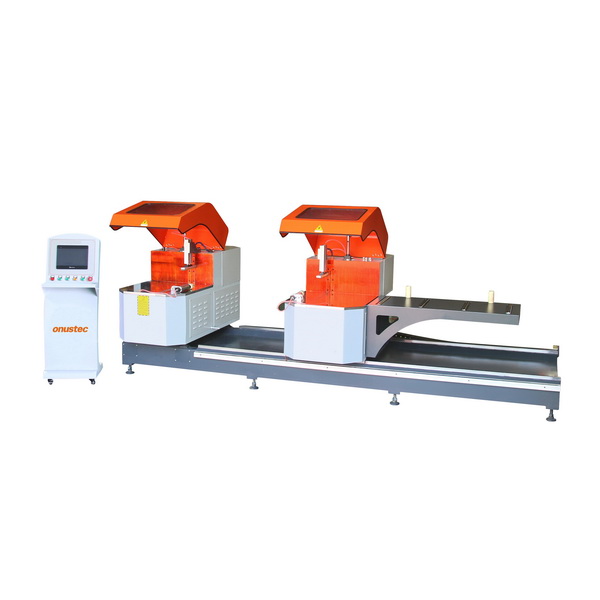
The most common mistake buyers make is selecting a saw based solely on blade diameter. While a 500mm or 600mm blade sounds impressive, the critical factor is actually the "feed direction"—how the blade enters the material. The physics of the cut must align with the structural properties of your profile to minimize vibration and ensure safety.
Every profile has strong points and weak webs. If a blade engages a thin wall incorrectly, it causes chatter. This vibration ruins the surface finish and dulls the blade prematurely. Therefore, the geometry of your profile—whether it is tall and narrow, or flat and wide—dictates the mechanical architecture you need.
In a back-cut system, the blade housing sits behind the fence and moves forward (radially) into the material. This is the workhorse of the window and door industry.
Best Application: Standard window profiles, door frames, and general industrial aluminum extrusions.
Pros: These machines offer exceptional flexibility. They typically feature a wide tilt range, allowing cuts tilting both inward (45°) and outward (135°). This versatility reduces the need for special jigs.
Limitations: They require horizontal clamping against the fence. While excellent for standard shapes, they may struggle with extremely wide, flat profiles (like wide sliding door tracks) because the blade stroke has a finite forward reach.
Up-cut saws feature a blade that rises from beneath the machine table. This design provides a heavily reinforced table surface, making it ideal for heavier sections.
Best Application: Wide, flat profiles such as curtain wall transoms, wide sliding door sills, and heavy industrial heat sinks.
Pros: Safety is a major advantage here; the blade retracts completely below the table between cycles, protecting the operator. The mechanics are extremely rigid, allowing for aggressive cutting of wide sections without deflection.
Limitations: Due to the table mechanics, these saws are typically limited to inward tilting only. They also rely heavily on vertical clamping pressure to hold the material down against the upward force of the blade.
Down-cut saws operate like traditional chop saws, where the head pivots down from above. While common in entry-level setups, they have distinct limitations in an industrial CNC environment.
Best Application: Budget-sensitive projects, low-volume fabrication, or simple cutoff operations where tolerance is less critical.
Decision Factor: While the initial price is lower, these units often lack the rigidity required for complex joinery. A High Precision Double Mitre Saw typically moves away from this design in favor of linear guides found in back-cut or up-cut models to ensure tighter angle control.
| Saw Type | Blade Movement | Ideal Profile Shape | Key Advantage |
|---|---|---|---|
| Back-Cut | Radial (Back to Front) | Tall & Narrow / Standard Frames | High tilting flexibility (In/Out) |
| Up-Cut | Rising (Bottom to Top) | Wide & Flat | Superior rigidity & Safety |
| Down-Cut | Pivoting (Top to Bottom) | Simple / Small Sections | Lower initial cost |
Precision is not just about a digital display showing "45.0 degrees." It is about the mechanical ability to hold that angle under the stress of cutting thick aluminum or steel-reinforced PVC. The drive architecture separates a standard machine from a production-ready asset.
Entry-level machines often use pneumatic cylinders to move the cutting head to position. While cheap, air is compressible, leading to "bounce" and positioning errors over long lengths. In contrast, a High End CNC Double Mitre Saw utilizes servo motors on a rack-and-pinion or ball screw drive system.
Servos provide absolute positioning. They constantly correct the head location via feedback loops, ensuring repeatability to within 0.1mm (0.004 inches) over thousands of cycles. For glazing beads or air-tight frame assembly, this precision prevents gaps that lead to rejected windows.
How the machine changes angles is just as important as how it cuts. Manual locking handles are prone to operator error and physical drift. An Automatic Double Mitre Saw should feature electronic angle setting. This allows the head to automatically transition between 45°, 90°, and intermediate angles based on the cut list.
The Drift Issue: During heavy cutting shifts, vibration can cause mechanical locks to slip slightly. High-quality CNC systems use rigid braking mechanisms or continuous servo holding torque to lock the angle. This prevents "angle creep," ensuring the 100th cut is identical to the first.
The direction of forces during the cut defines the finish quality. A superior design ensures the "Cut Down" advantage. This means the rotation of the blade and the movement of the head push the profile against the fence and down onto the table.
If the cutting geometry pulls the profile away from the fence, you get "chatter." Chatter creates rough, wavy surfaces that prevent tight mitre joints. Always verify that the clamping sequence and blade rotation work together to stabilize the workpiece, not destabilize it.
In a modern factory, a CNC saw cannot be an isolated island. It must function as a data terminal that executes instructions from your office. If an operator is manually typing dimensions into a keypad, you are losing money and inviting typing errors.
Your saw must speak the language of your design software. Verify that the machine accepts CSV, XML, or direct network inputs from window design packages (like Klaes, Orgadata, or indigenous ERPs). This seamless transfer eliminates manual data entry.
Furthermore, a true Multi Function Double Mitre Saw will offer onboard optimization. Instead of cutting parts in sequential order (which leaves random scrap), the software nests the required pieces into the raw bar length to maximize yield. It calculates the most efficient cutting order instantly, ensuring you get the most product out of every stock length.
Once a profile is cut, it looks identical to ten others. Without identification, operators waste hours sorting parts or, worse, weld the wrong pieces together. Look for integrated barcode printing capabilities. The saw should automatically print a label containing the project name, window ID, and next-step processing instructions. This is crucial for downstream operations, especially if you feed parts into CNC machining centers that scan barcodes to load milling programs.
Double mitre saws have a minimum distance between heads (often 300mm-400mm). Cutting pieces shorter than this usually requires manual intervention or a specialized "automatic cycle." Advanced machines handle this by cutting one end, automatically feeding the profile to a new position, and cutting the other end using a single head, all without operator hands entering the danger zone.
The sticker price of the machine is only one component of the cost. The Total Cost of Ownership (TCO) includes material yield, labor efficiency, and maintenance. Often, a more expensive automated system pays for itself within 12 to 18 months through operational savings.
Material cost usually exceeds labor cost in aluminum fabrication. If you process $500,000 of aluminum annually, a 5% reduction in scrap is worth $25,000 in pure profit every year. A Automatic Double Mitre Saw with advanced nesting software can consistently achieve 3% to 5% better yield compared to manual calculation or simple sequential cutting. This savings alone often justifies the upgrade to a CNC model.
Analyze the cycle time. A manual saw requires the operator to measure, mark, unlock the head, slide it, lock it, and cut. This takes 45-90 seconds per adjustment. A servo-driven system moves to position in under 3 seconds. Over a shift requiring 300 unique cuts, this difference is massive. It allows one operator to run a high-volume line that would otherwise require two or three manual stations.
High-speed aluminum cutting demands robust maintenance protocols.
Blades: Factor in the cost of high-quality TCT (Tungsten Carbide Tipped) blades. Cheap blades wander and ruin profiles.
Lubrication: Venturi mist spray systems are mandatory for aluminum to prevent aluminum chips from welding to the blade teeth. Ensure the machine has an accessible, easy-to-refill reservoir.
Electronics: Assess the availability of components. A machine built with standard industrial PLCs (like Siemens, Omron, or Mitsubishi) is easier to service than one using proprietary "black box" circuit boards that are obsolete in five years.
The machine is only as reliable as the company behind it. When selecting a vendor, look beyond the sales brochure to the support infrastructure.
Aluminum cutting involves high-speed rotating blades and flying chips. Ensure the equipment meets CE, OSHA, or your local safety standards. Critical features include dual-hand start buttons (forcing hands away from blades) and full enclosure guarding. Interlocks should prevent the guard from opening while blades are spinning.
Downtime kills profitability. Does the CNC Double Mitre Saw Manufacturer offer remote diagnostics? Modern PLCs allow technicians to dial into the machine via an internet connection to troubleshoot error codes or update software parameters. This capability can resolve issues in minutes rather than days waiting for a site visit. Additionally, verify they hold a local inventory of spare parts, particularly sensors, belts, and solenoid valves.
A powerful machine is useless if your team cannot run it. Evaluate the user interface. Is it graphical and visual, showing the profile orientation on screen? Or is it a complex code-based screen? User-friendly interfaces reduce the training curve and minimize the risk of operators loading profiles backward.
Choosing the right industrial saw is a strategic balance between physical constraints and production goals. Your profile geometry dictates the feed type (Back-cut vs. Up-cut), your production data dictates the automation level, and your quality standards dictate the drive precision.
For high-volume production, the initial premium of a fully automated, servo-driven system is quickly recovered. The combination of material savings through nesting, labor reduction through automation, and the elimination of secondary finishing costs creates a compelling ROI. We recommend auditing your current "scrap rate" and "setup time" before requesting a quote. Understanding these hidden costs will clarify exactly which features you need.
A: While often used interchangeably, "mitre" specifically implies the ability to cut angles (usually 45° and 90°). A generic "double head cutting machine" might only perform straight 90° cutoff operations. Always verify the angular range (e.g., 22.5° to 135°) if your application requires complex joinery.
A: Yes, most CNC saws can handle both, but the setup differs. Aluminum requires higher blade RPMs and a mist lubrication system (cooling). PVC typically cuts dry at slightly different speeds. If you cut both, ensure the machine allows for variable speed control and toggling the lubricant on/off.
A: Up-cut saws position the blade mechanism below the table, allowing for a large, flat, unobstructed work surface. This geometry provides superior stability for wide profiles like sliding door tracks or curtain walls. The rising blade action also naturally presses the wide profile flat against the back fence for accuracy.
A: You need significantly more than just the machine length. For a 5-meter cutting capacity, the machine itself may be 6-7 meters long. However, you must account for profile loading racks on the left and unloading space on the right, plus safety cages. A typical footprint plan should allocate a 10m x 2m area for safe operation.


