
Views: 0 Author: Site Editor Publish Time: 2026-08-17 Origin: Site


Scaling production capacity often hits a hard ceiling when relying on single-head or manual cutting stations. The reliance on manual measurement results in inconsistent angles, bottlenecked throughput, and unacceptable levels of material waste. For manufacturers of windows, doors, and industrial aluminum profiles, the transition to a CNC Double Mitre Saw represents a shift from simple power tools to genuine industrial automation. This transition is not merely about cutting faster; it is about digitalizing the entire workflow, moving seamlessly from CAD designs to finished cuts.
However, selecting the right equipment requires moving beyond basic definitions. You must evaluate structural rigidity, software ecosystem compatibility, and the true return on investment (ROI). This guide moves past surface-level features to provide decision-grade evaluation criteria for operators and buyers ready to modernize their production lines.
Precision is Structural: Why flex in cheaper construction-grade saws makes perfect 45° joints impossible.
Geometry Matters: The critical difference between Up-cut, Down-cut, and Back-cut mechanisms for your specific profile type.
The Hidden Cost: Why blade quality (negative rake, high tooth count) and dust collection define 50% of the machine's success.
Software First: The machine is only as fast as the data stream feeding it—integration with window/door software or ERP is non-negotiable.
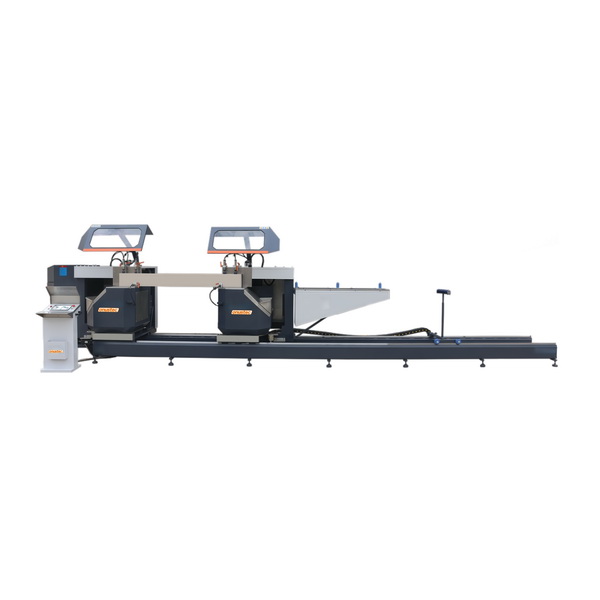
The decision to upgrade usually stems from a specific business problem: your cutting department cannot keep pace with assembly. To validate this significant capital expense, you must frame the investment through the lens of efficiency, yield, and labor allocation.
Manual cutting follows a linear, slow cycle: measure, mark, clamp, cut, unclamp, and measure again. This process is prone to human error and fatigue. In contrast, an Automatic Double Mitre Saw operates on a batch load and auto feed cycle. Operators load the raw extrusion, select the program, and the machine executes simultaneous cuts at both ends.
Industry benchmarks suggest that while a skilled manual operator might process 50 to 80 pieces per hour, a CNC-integrated double head saw can often exceed 500 cuts per hour depending on the profile complexity. This tenfold increase in throughput removes the primary bottleneck in fabrication shops.
Scrap aluminum is money left on the floor. Manual operators often cut pieces in the order they appear on a paper list, which is rarely the most efficient way to utilize a 6-meter stock bar. CNC systems utilize nesting software to analyze the entire day’s cut list. They rearrange the cutting order mathematically to maximize material yield.
If a digital nesting solution saves just 4% of material costs annually, the savings often cover the machine payments. This shifts the calculation from how much does the machine cost? to how much is my current waste costing me?
Finding master carpenters or highly skilled fabricators who can read complex blueprints and cut perfect miters by hand is increasingly difficult. Automation shifts the reliance from craftsmanship to process management. A machine operator does not need to know trigonometry to cut a complex compound angle; they simply need to know how to load the material and safety protocols. This allows you to deploy your most skilled staff to assembly and quality control, where their expertise adds more value.
At what point does the investment make sense? If your shop cuts fewer than 100 sticks a day, manual methods may suffice. However, once production exceeds 300 to 500 cuts daily, or if you handle complex architectural profiles requiring frequent angle changes, the tipping point arrives. This is where a Multi Function Double Mitre Saw pays for itself by ensuring that increased volume does not result in increased error rates.
Not all double miter saws are created equal. The market is flooded with construction grade equipment masquerading as industrial machinery. Understanding the mechanical differences is vital for long-term reliability.
Precision is heavy. In cheaper construction-grade saws, manufacturers use stamped steel bases and lighter components to reduce shipping weight and cost. The problem arises during operation. When a saw blade hits a thick aluminum wall, it creates vibration. Stamped steel allows the motor and blade to deflect or flex microscopically. This deflection results in cuts that are not perfectly 90° or 45°, leading to gaps in the final joint.
A High End CNC Double Mitre Saw utilizes cast iron beds and heavy steel gantries. This mass acts as a dampener, absorbing the harmonic vibrations generated by cutting. Rigidity ensures that the blade remains perfectly true throughout the cut, regardless of the material density.
The mechanism by which the blade enters the material defines the machine's capability and safety profile. There are three primary configurations:
| Mechanism | Motion | Best Application | Pros & Cons |
|---|---|---|---|
| Down-cut (Chop Style) | Blade descends from above. | General-purpose cutting; simple profiles. | Pros: Common entry-level design. Cons: Risk of material lifting if not clamped heavily; debris flies upward. |
| Up-cut (Rising Blade) | Blade rises from under the table. | Wide, flat profiles (e.g., sliding door tracks, curtain walls). | Pros: Safest for operators (blade retracts); excellent dust extraction. Cons: Requires wider table space. |
| Back-cut (Radial) | Blade moves forward from the rear. | Tall, narrow profiles; complex angles. | Pros: Highest flexibility for compound cuts. Cons: Larger machine footprint required. |
Even the most expensive machine will perform poorly with incorrect tooling. A High Precision Double Mitre Saw is useless without a blade designed for the specific material.
Tooth Count: For smooth finishes on aluminum, specs should look for 80 to 100+ teeth (depending on diameter).
Grind Geometry: Triple Chip Grind (TCG) is the standard for non-ferrous metals, balancing cutting life with finish quality.
Rake Angle: A Negative Rake angle is crucial for aluminum. It prevents the blade from grabbing or climbing the material, which is a major safety hazard and a cause of rough finishes.
Buying a machine based on today's projects often leads to regret tomorrow. You must size the machine for the largest profile you intend to cut in the next three years.
Blade diameter dictates your vertical and horizontal cutting limits. A standard 450mm blade suffices for most residential window profiles. However, if you plan to fabricate curtain walls, storefronts, or heavy industrial extrusions, a 500mm or 600mm blade is necessary. Do not under-spec this component; you cannot upgrade blade capacity later without replacing the entire machine head.
Length capacity is equally important. Standard beds handle 4 or 5 meters. If you work with architectural profiles that arrive in 6-meter lengths and require long continuous cuts, ensure the machine bed accommodates this without awkward extensions that compromise accuracy.
Basic double mitre saws offer fixed stops at 45° and 90°. This works for standard frames but limits flexibility. Variable Angle CNC control allows the heads to rotate to any degree (e.g., 22.5° or 67.5°) via digital input. Furthermore, consider if you need compound cutting—where the blade tilts and rotates simultaneously. This is often required for complex facade work or decorative trim.
Avoid buying a generic machine. Adopt a Product First philosophy. Gather technical drawings of your three largest and most complex profiles. Present these to the manufacturer and ask: Can this machine cut this specific geometry at a 45-degree angle in one pass? If the motor housing hits the profile before the cut is finished, the machine is the wrong fit, regardless of its price.
In modern manufacturing, hardware is only as effective as the software driving it. The digital ecosystem determines how seamlessly the saw integrates into your business.
Evaluate the User Interface (UI). Is it a proprietary, closed system that is difficult to update, or is it Windows-based? Windows-based systems generally offer easier networking, remote support capabilities, and a file structure familiar to your IT team.
Manual data entry is the enemy of speed. A robust system handles data integration natively:
Cut Lists: The machine should accept import files (.CSV, .XML) directly from your window design software or ERP. This eliminates the risk of an operator misreading a 7 for a 1.
Label Printing: Immediate part identification is vital. As the saw completes a cut, it should automatically print a label with a barcode, part number, and next-step routing information. This facilitates downstream assembly and prevents parts from getting lost.
Software also manages safety. Modern CNC saws utilize sensors and interlocks. The system should prevent the cycle from starting if the pneumatic clamps are not fully engaged or if the pressure is below a safe threshold. Blade guarding standards must meet local regulations, ensuring the operator cannot access the cutting zone while the blade is in motion.
Once the machine is ordered, the real work begins. Successful implementation relies on infrastructure and discipline.
A sophisticated machine requires a stable environment.
Power: CNC controllers are sensitive to voltage spikes. Ensure you have stable 3-phase power, potentially conditioned by a stabilizer.
Air Supply: Pneumatic clamping requires consistent pressure and volume (CFM). If your shop air pressure drops when another tool turns on, the clamps may loosen during a cut, causing dangerous shifts.
Dust Collection: Aluminum chips are disastrous for linear guides and sensors. High-velocity extraction is mandatory, not optional. Poor chip evacuation is the leading cause of premature mechanical failure.
Consistency comes from routine. Establish clear SOPs immediately:
Calibration: Perform a First Article Inspection at the start of every shift. Cut a test square and measure the diagonals to verify the 45° angles.
The Depth Limiter: Adjust the blade stroke to the profile height. There is no need for the blade to travel 200mm for a 50mm profile; optimizing this saves seconds per cycle.
Feeding Speed: Match the hydro-pneumatic feed rate to the material hardness. Pushing too fast creates burrs; going too slow generates heat and reduces blade life.
Before finalizing your purchase, interrogate the CNC Double Mitre Saw Manufacturer about their support infrastructure. Do they stock critical spare parts like belts, sensors, and servo motors locally, or will you wait weeks for shipping? Does the machine allow for remote diagnostics? Being able to have a technician log in remotely to troubleshoot a software glitch can save days of downtime.
A CNC Double Mitre Saw is a capital asset that fundamentally transforms your production logic. It shifts your operation from a reliance on manual skill to a data-driven manufacturing process. When evaluating options, look beyond raw horsepower. Prioritize structural rigidity, safety features, and deep software integration.
To build your internal business case, start by auditing your current waste rates and total cutting hours. Understanding these hidden costs will reveal the true value of automation. Choose a partner, not just a vendor, and select a system that grows with your production volume.
A: The difference lies in the blade movement. In a Down-cut saw, the blade descends onto the material, which is common for general cutting but requires heavy clamping to prevent lifting. In an Up-cut saw, the blade rises from beneath the table. Up-cut saws are generally safer as the blade retracts into the housing after the cut, and they are superior for wide, flat profiles like sliding door tracks due to better chip evacuation and table support.
A: Yes. While designed primarily for aluminum, these saws can effectively cut PVC (vinyl) and other non-ferrous metals like copper or brass. They can also cut hardwoods. However, switching materials requires changing the saw blade to one with the correct tooth geometry and adjusting the blade RPM and feed rate to prevent burning or melting the material.
A: Industrial-grade CNC double mitre saws are engineered for high precision. You should expect length accuracy within ±0.1mm (or even tighter on premium models) and angular tolerance within ±0.1°. Achieving this requires a rigid machine base, proper calibration, and ensuring the material is perfectly straight and securely clamped during the cycle.
A: You will almost certainly need a three-phase power supply. Industrial CNC motors and servo drives require the stability and power delivery of three-phase electricity to maintain torque under load. While some very small, hobbyist-level units might run on single-phase, any machine capable of production-level throughput will require 3-phase power.
A: Routine maintenance is vital for longevity. Key tasks include daily cleaning of aluminum chips (especially from sensors and rails), checking pneumatic oil levels, and greasing linear guides and bearings weekly. You must also regularly inspect the blade for dullness or chipped teeth and verify the belt tension on the motor drives to ensure consistent cut quality.


