
Views: 0 Author: Site Editor Publish Time: 2026-08-31 Origin: Site


Processing complex architectural profiles with traditional 3-axis or single-head saws creates significant production bottlenecks. Fabricators often face high scrap rates and increased labor costs because basic cutting methods require manual secondary adjustments to achieve precise compound angles. The industry transition to the 5-Axis CNC Double Mitre Saw represents a fundamental shift from simple rough cutting to finished part production in a single pass.
This evolution eliminates the need for moving parts between stations, ensuring that complex cuts for curtain walls, automotive components, and sunrooms are accurate immediately off the machine. This guide moves beyond basic specification sheets. We will analyze the architectural features, software capabilities, and mechanical engineering requirements that determine long-term ROI for aluminum and industrial profile fabricators.
Compound Angle Dominance: 5-axis geometry allows for simultaneous mitering and tilting, eliminating the need for re-fixturing complex façade and automotive profiles.
Servo-Driven Accuracy: Closed-loop servo systems outperform pneumatic clamps and feeds, offering repeatability within ±0.1mm over 6000mm lengths.
Software is the Limit: The machine’s hardware is only as valuable as its ability to import directly from optimization software (CSV/XML) without manual data entry.
Structure Matters: Heat-treated, heavy-duty frames are non-negotiable for dampening vibration during high-speed cutting of thick-walled profiles.
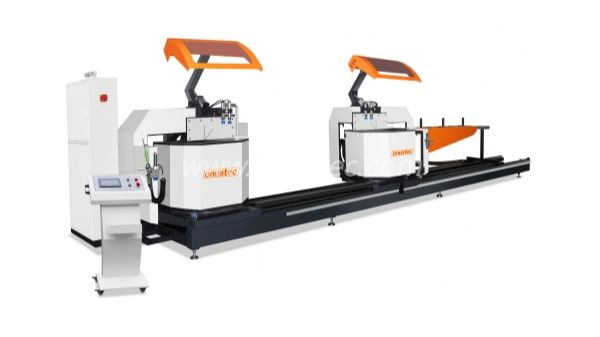
The primary distinction of a 5-axis system lies in its ability to manipulate the cutting head in multiple planes simultaneously. While standard double mitre saws utilize three axes (linear movement of the mobile head and rotation of both blades), true 5-axis architecture adds tilting capabilities to both cutting heads. This geometric freedom transforms how fabricators approach complex designs.
Understanding the difference between rotation and tilting is critical for evaluating machine capabilities. Rotation typically refers to the blade swinging around a vertical axis (e.g., 45° to 90° to 135°). Tilting involves the blade leaning relative to the horizontal plane. A high-performance Multi Angle CNC Double Mitre Saw combines these movements with XYZ linear travel.
This combination handles impossible cuts frequently found in curtain wall construction and sunlight rooms. For instance, creating a corner joint for a pyramid skylight requires a simultaneous 45° tilt and a 22.5° miter. A 3-axis machine cannot perform this in one setup. It requires the operator to cut the miter, unclamp the part, rotate it, and cut the tilt manually. This manual intervention destroys accuracy. Five-axis interpolation executes both angles instantly, ensuring the geometry matches the CAD drawing perfectly.
Advanced fabrication often requires different operations at each end of a profile. A Multi Function 5-Axis CNC Double Mitre Saw provides the flexibility to operate heads independently for asymmetrical cuts or synchronously for parallel processing. Synchronization is vital for batch production where both ends require identical compound angles.
The bottom-up blade presentation is another crucial factor in geometric precision. Unlike radial arm saws or chop saws that descend onto the profile, bottom-up saws elevate the blade through the material. This method is safer as the blade remains retracted inside the machine bed when not cutting. More importantly, it provides superior stability. The cutting forces drive the profile firmly against the back fence rather than lifting it, resulting in cleaner finishes on complex compound angles.
Investing in 5-axis technology is often justified by the removal of secondary processes. The traditional workflow involves multiple handling steps that introduce error and consume time. We can quantify this advantage by analyzing the workflow differences.
| Workflow Stage | Traditional 3-Axis Process | 5-Axis CNC Process |
|---|---|---|
| Primary Cut | Cut to length (Rotation only). | Cut length + Compound Angle + End Ops. |
| Secondary Setup | Move part to manual mill or tilt saw. | Eliminated. |
| Fixture Time | Requires re-clamping and re-measuring. | Single clamping setup. |
| Scrap Risk | High (Human error during re-positioning). | Near Zero (Computer controlled). |
| Total Cycle Time | 15 - 20 minutes per complex bar. | 2 - 4 minutes per complex bar. |
In high-precision manufacturing, the method of movement control defines the final part quality. Modern production environments demand consistency that pneumatic systems simply cannot provide.
A Servo Driven CNC Double Mitre Saw is now the baseline requirement for architectural aluminum and industrial applications. While pneumatic cylinders are cheaper, they suffer from stick-slip effects and air compressibility issues. As a machine warms up or air pressure fluctuates in the factory, pneumatic feed rates can become inconsistent.
Servo systems operate on a closed loop. They provide constant torque monitoring and position feedback to the controller. If the blade encounters a thicker section of the profile, the servo maintains precise speed rather than stalling or surging. This control prevents the drift common in pneumatic systems during long shifts, ensuring that the 100th part cut in the afternoon is identical to the first part cut in the morning. Position accuracy typically holds within ±0.1mm over lengths exceeding 6000mm.
Mechanical rigidity is the foundation of accuracy. When evaluating a machine, prioritize thermally stabilized, welded steel beds. The process of normalization—heating the steel frame and cooling it slowly—relieves internal stresses created during welding. Without this, a frame will warp over time, twisting the linear guides out of alignment.
Vibration dampening is equally critical. Cutting thick-walled industrial aluminum profiles generates significant high-frequency vibration. Lighter frames allow this vibration to transfer to the cutting head. This causes micro-fractures in carbide blade tips and results in chatter marks on the cut surface. A heavy, high-mass base absorbs this energy, extending blade life and ensuring a mirror-like finish.
The mechanism moving the mobile head impacts machine longevity. Precision linear guides, such as those from Hiwin or Rexroth, offer superior performance compared to simple roller bearings. Linear guides distribute the load across a wider surface area and offer tighter tolerances. Furthermore, high-quality guides feature superior sealing against aluminum dust and chips, which are abrasive and can destroy unprotected bearings rapidly.
Hardware capabilities are irrelevant if the data workflow creates a bottleneck. A common pitfall for buyers is selecting a machine with a proprietary black box controller that refuses to communicate with external systems.
Avoid controllers that require manual programming at the console for every job. This approach relies heavily on the operator's skill and typing accuracy. Modern manufacturing requires machines that act as peripherals to a central ERP or design system. The machine should execute instructions, not just accept manual keystrokes.
Top-tier systems support seamless importing of cut lists via LAN or Wi-Fi. Standard formats like .csv, .xml, and .dxf allow office engineering teams to send production batches directly to the saw. Barcode and QR code integration further streamlines this process. An operator simply scans a work order, and the machine automatically loads the correct profile program, positions the heads, and sets the angles. This scan-to-load functionality virtually eliminates operator error regarding profile selection.
Advanced controllers do more than just cut; they optimize. When processing linear bars, the software calculates the most efficient nesting of parts to maximize material yield. Effective nesting logic can reduce off-cut waste from a typical 15% down to less than 3%. The user interface facilitates this by moving away from archaic G-Code programming. Instead, operators use visual, object-oriented touchscreen interfaces. They see a 3D representation of the part, making it easy to verify cuts without needing to be a skilled CNC programmer.
The definition of a saw has expanded. Modern 5-axis units often function as compact machining centers, handling tasks that previously required separate stations.
Fabricators increasingly request machines equipped with small milling spindles or drilling units mounted alongside the saw blade. A Compound Angle CNC Double Mitre Saw with these features can perform end-milling or drill connector holes during the cutting cycle. This consolidation reduces floor space requirements and capital investment by removing the need for a dedicated machining center for simple end-prep work.
Blade selection dictates the machine's capacity. Large diameter blades, typically between 500mm and 600mm, are necessary for high-capacity profiles used in curtain walls. Conversely, smaller blades may be preferred for precision trim work to minimize kerf waste.
Cooling systems play a vital role in cut quality. Flood coolant systems are becoming less common due to the mess they create. Micro-mist lubrication, or Minimum Quantity Lubrication (MQL), is the preferred standard. It sprays a precise amount of lubricant directly onto the blade teeth. This keeps the shop floor clean and dry while effectively preventing aluminum from adhering to the blade, which is the primary cause of poor surface finish.
Long profiles suffer from gravity. As the cutting heads move apart to cut a 6-meter bar, the profile can sag in the middle if unsupported. This sagging changes the angle of the profile relative to the blade, ruining the compound cut. Advanced saws utilize Follow-up Carriers or servo-supports. These supports automatically position themselves equidistant between the heads, ensuring the profile remains perfectly level throughout the process.
High-speed carbide blades pose significant safety risks. Modern machine design focuses heavily on isolating the operator from these hazards while maintaining productivity.
Evaluators should look for Full Enclosure designs rather than open tables. A full enclosure serves two purposes: safety and hygiene. It creates a physical barrier between the operator and the moving head. Additionally, it contains the high-decibel noise generated by cutting aluminum and effectively captures chips and dust. Open designs allow aluminum dust to migrate throughout the factory, posing respiratory risks and contaminating other sensitive equipment.
Intelligent machines monitor their own status. Sensor-based clamping detection prevents the blade from starting if the profile is not held at the correct pressure. If a clamp fails or an air line leaks, the machine halts immediately. Furthermore, servo-driven dust hoods are a premium feature to look for. These hoods automatically adjust their height based on the profile size, maximizing suction efficiency right at the source of the cut.
Operator fatigue leads to errors. Ergonomic designs feature low loading heights, allowing operators to slide heavy industrial extrusions onto the bed without lifting them above waist height. Unobstructed access to the bed facilitates easier maintenance and cleaning, encouraging operators to keep the machine in prime condition.
Choosing the right partner is as important as choosing the right machine. Not all equipment is built to the same standard, even if the spec sheets look similar.
When vetting a 5-Axis CNC Double Mitre Saw Manufacturer, demand transparency. Request a Bill of Materials audit. Reliable manufacturers use globally recognized components. Are the servos from Yaskawa or Schneider, or are they unbranded generic units? Is the pneumatic system powered by SMC or Festo? These components determine the ease of future maintenance and spare parts availability.
Installation quality dictates accuracy. Ask about volumetric laser compensation. This advanced calibration method maps the machine's entire working volume and compensates for minute geometric errors in the software. Additionally, ensure the manufacturer offers remote diagnostic capabilities. The ability for a technician to log in remotely to clear software faults or update parameters can save days of downtime compared to waiting for a site visit.
Purchase price is only one part of the equation. A cheaper machine with a lightweight frame may vibrate, reducing blade life by 50%. If you spend $500 on blades twice as often, the operational costs skyrocket. Balancing higher upfront costs for a rigid, servo-driven machine against lower consumable costs and reduced scrap rates typically reveals a faster ROI for high-volume fabricators.
A 5-Axis Double Mitre Saw is not merely a cutting tool; it functions as a dimensional quality control station that dictates the precision of your entire assembly line. By integrating complex compound angles, drilling, and milling into a single workflow, these machines redefine efficiency for architectural and industrial fabricators.
Decision-makers should prioritize rigid mechanical construction and open software architecture over theoretical maximum cutting speeds. A fast machine that cuts inaccurately only produces scrap faster. We encourage you to request a specific time study based on your own profile drawings. Seeing your parts processed in real-time provides the only true validation of performance.
A: A 3-axis saw controls the linear position of the head and the rotation of the two blades. A 5-axis saw adds the ability to tilt the blades simultaneously. This combination of rotation, tilting, and linear movement allows for the creation of complex compound angles required for curtain walls and pyramids without needing to reposition the material.
A: Servo systems provide closed-loop feedback, offering consistent speed and positioning accuracy within ±0.1mm. Unlike pneumatic systems, servos do not suffer from bounce when the blade engages the material and are immune to air pressure fluctuations, ensuring stable cutting feed rates even during heavy cuts.
A: Yes, many advanced 5-axis saws are multi-function and can be equipped with small milling or drilling modules. However, these are typically designed for light machining tasks like connector holes. For heavy-duty milling or large notches, a dedicated CNC machining center might still be required depending on the cycle time.
A: The ROI is typically driven by material yield improvements and labor reduction. By using nesting software to reduce waste from 15% to 3% and eliminating secondary manual setup steps, high-volume shops often see a return on investment in 12 to 18 months compared to traditional cutting methods.
A: Blade deflection is managed through proper machine rigidity and programming. Using large blade flanges helps stabilize the core. Additionally, programming a slow-entry speed allows the blade to establish a groove before ramping up to full speed. Ensuring the profile is clamped securely near the cut zone also minimizes vibration and deflection.


