
Views: 0 Author: Site Editor Publish Time: 2026-08-03 Origin: Site


Cutting to length (CTL) is often the primary bottleneck in door, window, and frame manufacturing. Even the fastest assembly line halts if the saw operator struggles to measure twice and cut once. This bottleneck forces a critical choice between two distinct technologies. On one side stands the manual double mitre saw, where an operator physically positions the head and reads a scale. On the other sits the CNC Double Mitre Saw, utilizing servo-controlled positioning driven by advanced software.
This decision goes beyond simply upgrading to better technology. It represents a strategic balance between Capital Expenditure (CapEx), labor availability, and material yield. While manual saws offer simplicity and lower entry costs for low-volume custom shops, CNC variants are often a mathematical necessity. For businesses scaling beyond 50 cuts per hour, the CNC Double Mitre Saw provides essential yield optimization and error reduction that manual operations cannot match.
Speed is Secondary to Setup: CNC machines win on changeover time (moving from one length to another), not necessarily just cutting speed.
The Hidden Cost of Manual: Manual saws rely heavily on operator skill for accuracy; human measurement errors account for 3–5% of material waste in manual setups.
Labor Dependency: CNC saws allow entry-level operators to produce master-level precision; manual saws require experienced technicians to maintain tolerance.
Integration Capabilities: Only Automatic Double Mitre Saws can integrate directly with ERP cut lists to eliminate data entry errors.
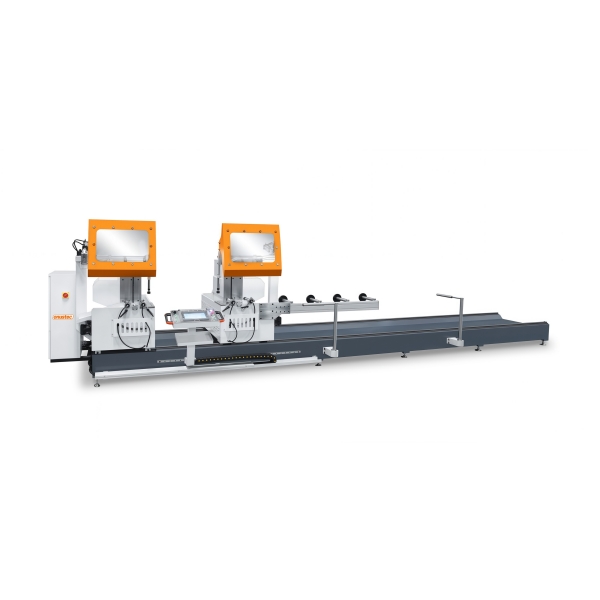
The definitions of manual and CNC equipment might seem academic on paper, but they dictate the physical reality of your shop floor. Understanding the minute-by-minute workflow reveals where efficiency is lost or gained.
In a manual setup, the operator serves as the machine's brain and measuring tape. They read a paper cut list, often deciphering handwritten notes. Next, they must manually unlock the mobile head of the saw. They slide it along the rail to the visual ruler mark and lock it back down. This process introduces a significant friction point. Micro-adjustments are slow and frustrating. Furthermore, parallax error—viewing the ruler from a slight angle—causes inconsistencies between operators. One technician might cut a millimeter shy, while another cuts a millimeter long.
Contrast this with an Automatic Double Mitre Saw. Here, the operator simply scans a barcode or loads a batch file from a network. The machine takes over immediately. It positions the cutting head via a ball screw or rack and pinion system. This movement is instant and accurate to within 0.1mm. The primary advantage is repeatability. You can set it and forget it across thousands of cycles without fatigue affecting the outcome.
Buyers must beware of the semi-auto category. Many machines market themselves as advanced because they feature a digital readout display. While these screens display numbers, the operator must still physically move the head. These units lack true optimization capabilities. They act as glorified rulers rather than production partners.
Accuracy in manufacturing is not just about hitting a dimension once; it is about hitting it every single time, regardless of vibration or wear. This is where the mechanical differences become stark.
Manual saws generally rely on friction brakes or pneumatic clamps to hold the cutting head in place. These mechanisms are simple but imperfect. Over the course of an eight-hour shift, machine vibration can cause these brakes to slip microscopically. This leads to tolerance drift, where parts cut in the afternoon differ slightly from those cut in the morning. Conversely, a High Precision Double Mitre Saw utilizes absolute encoders and servo motors. These systems correct the position in real-time, actively fighting drift to maintain exact coordinates.
Cutting straightforward 45-degree angles is standard, but complex framing often requires compound angles. Manually setting these angles is time-consuming and prone to error. A Multi Function Double Mitre Saw controls angular rotation via CNC. This allows for precise, automated adjustments that a human operator cannot reliably duplicate by eye.
Consider the downstream financial impact of a minor error. If a profile is cut 1mm too short in window fabrication, the gap prevents proper sealing. This ruins the entire sash, wasting the profile, the glass, and the labor invested up to that point. CNC technology mitigates this risk entirely by removing the human variable from the measurement equation.
The most compelling argument for automation is often material cost. For many manufacturers, raw material represents the largest line item on the profit and loss statement.
Manual operators typically process orders sequentially. They cut the first item on the list, then the second, and so on. This linear approach inevitably leads to significant offcut waste at the end of a stock bar. A human cannot mentally calculate the optimal combination of twenty different cut lengths to fit a 6-meter extrusion instantly.
CNC software changes this dynamic through nesting. The controller calculates the mathematical best combination of lengths to maximize the raw material bar. It might cut piece #1, then piece #15, then piece #4, simply because they fit perfectly together.
| Feature | Manual Operation | CNC Optimization |
|---|---|---|
| Cut Strategy | Sequential (Order 1, 2, 3...) | Nested (Mathematically fit) |
| Average Waste | 15% - 20% | 3% - 5% |
| End-of-Bar Mgmt | Large, unusable offcuts | Minimal scrap chips |
The ROI math is straightforward. A 15% reduction in expensive aluminum or hardwood waste often pays for the price difference of the CNC machine within 12 to 18 months.
Beyond nesting, scrap management improves. CNC systems often include automatic trim cuts to square the raw ends of a bar. Manual operators, under pressure to move fast, might skip this step. Skipping trim cuts compromises joint quality, leading to open mitres and rejected products.
The manufacturing sector faces a persistent shortage of skilled labor. This reality forces companies to rethink how they staff their cutting departments.
Finding a master carpenter or an expert fabricator is the number one challenge for shop managers. A CNC saw solves this by de-skilling the cutting process. It allows a junior operator to simply load profiles and press Start. The skill resides in the machine, not the person. You no longer need to rely on a single employee's tenure to guarantee quality.
Safety differences are equally stark. In manual setups, operators often stand close to the spinning blades. They may manually hold material or actuate clamps, putting their hands near the danger zone. Conversely, CNC machines are usually fully enclosed. They feature safety interlocks and automated pneumatic clamping. This design removes hands entirely from the crush zone, lowering insurance liability and boosting morale.
When you compare output, the difference is massive. One CNC operator can often outproduce two manual saw stations. This efficiency comes from the total elimination of measuring time. The machine moves while the operator prepares the next bar, creating a continuous flow.
Modern manufacturing is connected. Standalone machines create data silos, while integrated machines create ecosystems.
Consider the workflow of a High End CNC Double Mitre Saw. Cut lists are generated in design software like KaluCAD or WindowMaker. These lists are sent directly to the saw over the network. This eliminates the fat finger typing errors that occur when operators manually enter dimensions at the controller. The data remains pure from design to execution.
High-end units frequently include automated label printing. As each part is cut, a label is generated for tracking. This is crucial for large assembly lines where parts look identical but have different destinations. Manual saws require handwritten marking, which is slow and often illegible.
A manual saw is a standalone island. It cannot communicate. A CNC saw acts as a node in a connected factory, ready for Industry 4.0. As your business grows, the CNC saw scales with you, integrating into more complex ERP environments.
The sticker price is only the first component of the total cost. A wise investment analysis looks at the full lifecycle of the machinery.
We must acknowledge the price gap. Manual saws are typically 30–50% the cost of a basic CNC model. They are even cheaper compared to a multi-axis system. For startups with limited capital, this initial savings is a powerful motivator. However, this short-term gain often leads to long-term operational bleeding.
Maintenance profiles differ significantly. Manual saws require low maintenance, mostly mechanical lubrication and blade changes. CNC machines are more complex. They require PC maintenance, drive calibration, and clean electrical environments. It is vital to choose a reliable CNC Double Mitre Saw Manufacturer who offers robust technical support. Downtime on a high-output machine is more expensive than downtime on a manual saw.
Finally, consider the exit strategy. Industrial CNC machinery holds its value better in secondary markets compared to basic manual equipment. If you upgrade or liquidate, the CNC saw remains a desirable asset.
The choice between manual and CNC technology defines the ceiling of your production capacity. For custom workshops doing under 50 cuts a day, or for bespoke prototyping where every cut is unique, a high-quality Manual Double Mitre Saw remains a solid choice. It offers control and simplicity without the overhead of programming.
However, for window and door manufacturers or industrial framers, the verdict changes. A CNC Double Mitre Saw is mandatory for high-volume production. The ROI generated from material savings, labor reduction, and error elimination outweighs the initial cost rapidly. Before you browse models, audit your current scrap rate and setup time. These two metrics will define your budget and dictate your decision.
A: Generally, no. Retrofitting servo motors, encoders, and controllers onto a manual frame is technically difficult and cost-prohibitive. It is usually cheaper and more reliable to buy a new CNC machine. Adding digital stops is a common middle ground, but it does not offer full automation.
A: The curve is short for operators, typically taking 1-2 days to learn loading and safety procedures. However, the production manager or technician setting up the software and network integration may need moderate training to master the optimization features.
A: The actual blade rotation speed is usually the same. However, the cycle time is significantly faster. CNC saws eliminate the measuring, marking, and manual positioning steps, making the total time to produce a finished part much shorter.
A: This relates to how the blade enters the material. Up-cut saws feature blades rising from under the table, which is safer and excellent for wide profiles. Back-cut saws bring the blade from behind, offering different capacity benefits. Both styles are available in manual and CNC configurations.
A: CNC saws require cleaner environments. You must maintain dust-free electrical cabinets and clean sensors regularly. Manual saws are more rugged regarding dust but require similar mechanical lubrication. Reliable power supplies are also critical for CNC electronics.


