
Views: 0 Author: Site Editor Publish Time: 2026-06-17 Origin: Site


In the high-stakes world of aluminum and PVC fabrication, efficiency is often lost in the smallest details. A manual angle setting that drifts by half a degree or a measuring error of two millimeters might seem negligible, but over a production run of thousands of window frames or curtain walls, these variances compound into a significant financial leak. The cost of material waste, commonly known as offcuts, and the labor hours spent on rework create a bottleneck that stifles growth. This is where the 3-Axis CNC Double Mitre Saw transforms from a simple cutting tool into a production backbone.
Unlike standard manual saws, this technology automates the three most critical variables of the cutting process: the precise length of the profile (X-axis) and the independent angular positioning of both cutting heads. By removing the "human factor" from calibration, manufacturers can achieve airtight joints and rapid throughput. This guide moves beyond basic definitions to explore the mechanism mechanics, Return on Investment (ROI) drivers, and the critical architectural decisions—such as choosing between Back-cut and Up-cut configurations—required for high-end manufacturing.
Definition: A 3-Axis system typically automates Head Positioning (Length) and the Miter Angles of both saw blades independently, removing manual calibration.
Core Benefit: Replaces "measure twice, cut once" with "program once, cut thousands" using Servo Driven precision to achieve zero-backlash tolerance.
Configuration Matters: The choice between Up-cut (wider profiles) and Back-cut (taller profiles) dictates your facility's capability.
ROI Driver: The primary financial gain isn't just speed; it is the software-driven optimization of raw bars to minimize waste percentages.
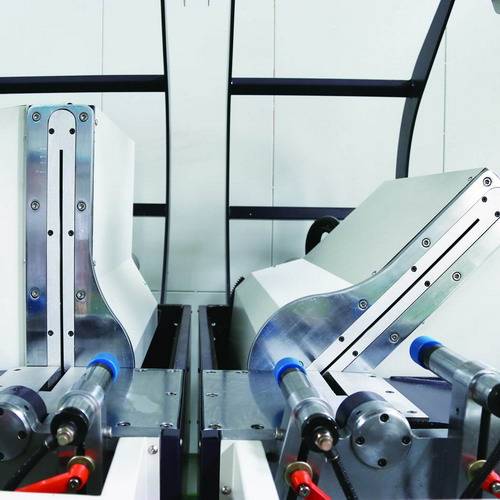
To evaluate a machine correctly, you must first understand the anatomy of its movement. In the broader world of CNC machining, axes usually denote spatial movement (X, Y, Z). However, in the specialized domain of profile cutting, the "3 Axes" refer to a specific choreography designed to handle long bars of aluminum or PVC.
While a milling machine moves a tool over a stationary part, a double mitre saw coordinates the movement of the machine heads themselves. The axes are typically defined as follows:
Axis X (Linear): This controls the mobile head's movement along the machine bed. It determines the cutting length with absolute precision. High-end models utilize rack-and-pinion systems or linear guides to position the head within fractions of a millimeter over lengths exceeding 6 meters.
Axis Y (Angular - Left Head): This axis controls the tilt or rotation of the fixed head. Instead of a manual lever, a motor drives the head to the exact degree required.
Axis Z (Angular - Right Head): This axis manages the rotation of the mobile head independently of the left one. This independence allows for complex trapezoidal cuts or asymmetric joinery without operator intervention.
Historically, fabrication shops relied on pneumatic cylinders to swing saw heads against hard mechanical stops—usually fixed at standard angles like 45° or 90°. While reliable for simple boxes, this method lacks flexibility. Modern production demands the Servo Driven 3-Axis CNC Double Mitre Saw.
By replacing pneumatic pistons with servo motors, manufacturers gain infinite angle adjustability. If a renovation project requires a frame cut at 45.5° to accommodate an out-of-square opening, a servo-driven system can adjust to that specific decimal. This capability offers 0.1-degree precision, ensuring that the final assembly fits perfectly on-site without field modification.
Precision is not just about moving to a spot; it is about staying there under the violent vibration of a carbide blade cutting through metal. To achieve this, engineers employ harmonic reducers or high-precision planetary gearboxes. These components eliminate "backlash"—the play or slack in a gear system.
If a machine lacks this zero-backlash rigidity, the blade may drift slightly as it engages the material. In window and door fabrication, even a microscopic drift results in corner joints that do not close tightly, compromising both aesthetics and weather sealing. Therefore, the mechanical transmission is as vital as the electronic controller.
The brain of the operation is the software interface. A true CNC system does not require an operator to type in dimensions manually, which is a primary source of error. Instead, the machine reads cutting lists directly from Enterprise Resource Planning (ERP) systems or window design software like Orgadata or Schucal.
These files (often in .CSV or .XML format) contain the entire day's production data. The machine parses this data, automatically positions the X-axis for length, and rotates the Y and Z axes for the required angles, streamlining the workflow from "design" to "done" in seconds.
When selecting a Multi Function 3-Axis CNC Double Mitre Saw, buyers often face a physical constraint dilemma. No single saw anatomy is perfect for every type of profile. The physical construction of the machine determines its "cutting envelope," effectively deciding what jobs you can and cannot bid on.
In an up-cut configuration, the saw blade sits beneath the table and rises upward to slice through the material. This design is the industry standard for specific applications.
Best For: Wide, flat profiles such as sliding door tracks, window sills, and curtain wall transoms. The wide table surface offers excellent stability for flat-laying parts.
Safety & Ergonomics: Because the blade retracts into the machine body, the enclosed cabinet acts as the worktable. This makes the machine inherently safer and significantly quieter during idle times.
Limitation: The mechanics of rising from below often restrict the "tilting" capacity. Performing complex compound angles (tilting and rotating simultaneously) is mechanically difficult in this layout.
Back-cut saws feature blades that are mounted behind the fence and stroke forward horizontally or radially. This architecture is favored for versatility.
Best For: Tall, narrow profiles and intricate Multi Angle 3-Axis CNC Double Mitre Saw operations. It excels at cutting high vertical profiles used in thermal break window systems.
Flexibility: The open geometry often allows for a wider range of tilting. Many models support "inside and outside" tilting, enabling the fabrication of complex geometric shapes that up-cut saws cannot reach.
Trade-off: These machines generally have a larger footprint. They also have more exposed moving parts, which necessitates robust safety zones and larger guarding cages to protect operators.
To simplify the decision, apply this basic logic to your production needs:
| Production Priority | Recommended Architecture | Why? |
|---|---|---|
| Wide Sliding Systems & Curtain Walls | Up-Cut Saw | Optimized for wide cutting capacities; superior stability for flat profiles. |
| Custom Framing & High Vertical Profiles | Back-Cut Saw | Allows for taller cutting envelopes and complex multi-angle flexibility. |
| High-Volume Standard Windows | Either (Based on Profile Height) | Focus on cycle speed and software integration rather than cutting geometry. |
Not all machines are created equal. When evaluating a quote from a 3-Axis CNC Double Mitre Saw Manufacturer, you must look beyond the brochure's top-line speed and examine the engineering that sustains precision over time.
There is a distinct difference between static accuracy and dynamic accuracy. Many saws can measure perfectly when the blade is stopped. However, a High End 3-Axis CNC Double Mitre Saw maintains that precision during the cut. Cutting heavy Hollow Structural Sections (HSS) or thick-walled aluminum generates significant vibration.
You must also consider the "Cantilever Effect." On a machine capable of cutting 4000mm or 6000mm lengths, the mobile head travels a long distance. Premium manufacturers stabilize this head with robust linear guides to prevent "droop" or misalignment at the far end of the bed. If the mobile head sags even slightly, long profiles will be cut with a compound error.
The way a machine holds the material is as important as how it cuts it.
Adaptive Clamping: Thin-walled PVC requires a delicate touch, while solid steel bars need immense holding force. Look for pressure-adjustable clamps that secure the workpiece without crushing or deforming it.
Profile Support: Long profiles tend to bow in the middle. If the profile sags between the two heads, the angle cut will be inaccurate. Roller conveyors and automatic intermediate supports are vital features that rise to support the bar, ensuring it remains perfectly straight during the cutting cycle.
Speed is money, but raw motor speed isn't the only factor. Evaluate the machine's "Short Piece" modes. Standard safety shields often prevent the heads from moving close together. Advanced machines automate the shield retraction or use offset strategies to cut short pieces rapidly without manual intervention. Additionally, look for rapid positioning speeds for the X-axis (ideally >40m/min) to minimize the wait time between cuts.
Investing in automation requires a clear path to profitability. The financial justification for a 3-axis saw revolves around Total Cost of Ownership (TCO) and strategic capability.
The shift from semi-automatic to fully automatic sawing impacts two main cost centers:
Labor: A manual double mitre saw often requires two operators—one to measure/set stops and one to load. A CNC version requires only one operator to load bars, as the machine handles all calibration.
Material: This is the largest ROI driver. "Dynamic Optimization" software calculates the most efficient way to cut a batch of orders from raw stock lengths. It can reduce scrap waste from a typical 15% down to less than 3%. Over a year, the savings on raw aluminum can often cover the machine's lease payments.
A common confusion in the market is whether to buy a saw or a tube laser. While lasers are powerful, they serve a different purpose.
Laser Pros: Capable of cutting infinite geometries, holes, and slots in a single pass.
Saw Pros: Saws are significantly faster for cut-to-length jobs. They offer "cold processing," meaning there is no Heat Affected Zone (HAZ) or discoloration on the profile edges—crucial for pre-painted or anodized aluminum. Saws are the volume workhorse; lasers are for complex detailing.
Verdict: If your primary need is cutting profiles to size with angled ends, the saw is the correct, cost-effective choice.
Finally, consider the asset's future. High-end servo-driven models retain their value far better than pneumatic versions. Software upgradeability means a used CNC saw can often be modernized, whereas a mechanical pneumatic saw becomes obsolete much faster.
Bringing a complex machine into a workshop introduces new risks. Mitigating these starts with the purchasing process.
The greatest risk is creating a "Data Silo"—buying a machine that cannot communicate with your existing window design software. You must ensure the manufacturer offers an open API or compatibility with standard industry files like .CSV or .XML. If your office team has to manually type cutting lists into the machine, you have negated the efficiency gains of the CNC system.
Additionally, pay attention to power requirements. Sensitive 3-axis CNC controllers can throw servo errors if your facility has unstable voltage. Voltage stabilizers are often a necessary add-on in industrial zones with fluctuating power.
Maintenance dictates longevity. For aluminum cutting, blade cooling is non-negotiable. Mist lubrication systems are superior to flood coolants for keeping the workspace clean, but they require regular refilling. Furthermore, optical sensors—used to detect profile presence—are vulnerable to blockage by swarf and chips. A well-designed machine cabinet will feature efficient chip extraction paths to keep these sensors clear.
Since the double mitre saw is often the start of the production line, it is a single point of failure. If the saw stops, the assembly line stops. Verify that the manufacturer offers remote diagnostic capabilities via Internet-connected PLCs. The ability for a technician to "dial in" to your machine and diagnose a servo fault remotely can save days of downtime compared to waiting for a site visit.
A 3-Axis CNC Double Mitre Saw is more than a purchase; it is a strategic asset that trades upfront Capital Expenditure (CapEx) for long-term Operational Efficiency (OpEx). By automating length and angle settings, you effectively purchase material savings and reduced rework capabilities.
The final decision tip is simple: Don't just buy for the profile you cut today. Buy for the complex, multi-angle profile you might need to bid on tomorrow. The flexibility of a servo-driven system ensures you are future-proofed against changing architectural trends.
As a next step, we recommend auditing your current waste percentages and profile dimensions. Armed with this data, you can contact a reputable 3-Axis CNC Double Mitre Saw Manufacturer to get a quote that reflects your true production needs.
A: A 3-axis saw automates the profile length (X-axis) and the two miter angles (Y and Z axes) of the heads. This covers most standard frame cutting. A 5-axis saw adds two more movements, typically allowing the blades to tilt (notch) or move radially to perform complex compound cuts or end-milling operations. 5-axis machines are significantly more expensive and are used for intricate curtain wall or facade geometries.
A: Yes, the machine mechanics can handle both, but the setup requires changes. Aluminum requires higher RPMs, specific blade tooth geometries (triple chip grind), and a mist lubrication system. PVC typically cuts at lower speeds and does not require lubrication. Most high-end CNC saws allow you to save different "Material Profiles" in the software to adjust these parameters automatically.
A: The improvement is drastic. Pneumatic saws rely on mechanical stops, usually limited to fixed angles (45°/90°) with a tolerance of roughly ±0.5mm due to wear. A servo-driven saw offers infinite adjustability and corrects for mechanical play, typically delivering angular precision of ±0.1 degrees and length precision of ±0.1mm. This eliminates the "gap" often seen in hand-assembled miters.
A: The training focus shifts from "manual skill" to "software operation." An operator no longer needs to be skilled at reading tape measures or calibrating angles manually. Instead, they need to learn how to load files and manage the machine interface. Generally, training time is shorter than for manual saws because the skill resides in the machine, not in the operator's hand.


